Wednesday, 30 September 2015
Thursday, 9 July 2015
Greece’s Final Bailout Proposal to the Creditors; Full Document of Reforms
This is Greece’s Final Bailout Proposal to the Creditors; Full Document of Reforms
by Anastasios Papapostolou - Jul 9, 2015
The Greek bailout proposal was sent via email to the president of the Eurogroup, Jeroen Dijsselbloem who will forward it to the rest of Greece’s creditors.
The Greek parliament which also received the draft, has been ordered to prepare an emergency vote on Friday that will approve the proposal as a basis for an agreement with Greece’s creditors: The International Monetary Fund (IMF), the European Central Bank (ECB), and the European Commission.
Here is Greece’s final bailout proposal in full:
Policy Commitments and Actions to be taken in consultation with EC/ECB/IMF staff:
1. 2015 supplementary budget and 2016-19 MTFS1
Adopt effective as of July 1, 2015 a supplementary 2015 budget and a 2016–19 medium-term fiscal strategy, supported by a sizable and credible package of measures. The new fiscal
path is premised on a primary surplus target of (1, 2, 3), and 3.5 percent of GDP in 2015, 2016, 2017 and 2018. The package includes VAT reforms (¶2), other tax policy measures (¶3),
pension reforms (¶4), public administration reforms (¶5), reforms addressing shortfalls in tax collection enforcement (¶6), and other parametric measures as specified below.
2. VAT reform
Adopt legislation to reform the VAT system that will be effective as of July 1, 2015. The reform will target a net revenue gain of 1 percent of GDP on an annual basis from parametric
changes. The new VAT system will: (i) unify the rates at a standard 23 percent rate, which will include restaurants and catering, and a reduced 13 percent rate for basic food, energy,
hotels, and water (excluding sewage), and a super-reduced rate of 6 percent for pharmaceuticals, books, and theater; (ii) streamline exemptions to broaden the base and raise the tax on
insurance; and (iii) Eliminate discounts on islands, starting with the islands with higher incomes and which are the most popular tourist destinations, except the most remote ones. This
will be completed by end-2016, as appropriate and targeted fiscally neutral measures to compensate those inhabitants that are most in need are determined. The new VAT rates on hotels
and islands will be implemented from October 2015.
The increase of the VAT rate described above may be reviewed at the end of 2016, provided that equivalent additional revenues are collected through measures taken against tax evasion
and to improve collectability of VAT. Any decision to review and revise shall take place in consultation with the institutions.
3. Fiscal structural measures
Adopt legislation to:
· close possibilities for income tax avoidance (e.g., tighten the definition of farmers), take measures to increase the corporate income tax in 2015 and require 100 percent advance
payments for corporate income and gradually for individual business income tax by 2017; phase out the preferential tax treatment of farmers in the income tax code by 2017; raise the
solidarity surcharge;
· abolish subsidies for excise on diesel oil for farmers and better target eligibility to halve heating oil subsidies expenditure in the budget 2016;
· in view of any revision of the zonal property values, adjust the property tax rates if necessary to safeguard the 2015 and 2016 property tax revenues at €2.65 billion and adjust the alternative minimum personal income taxation.
· eliminate the cross-border withholding tax introduced by the installments act (law XXXX/2015) and reverse the recent amendments to the ITC in the public administration act (law
XXXX/2015), including the special treatment of agricultural income.
· adopt outstanding reforms on the codes on income tax, and tax procedures: introduce a new Criminal Law on Tax Evasion and Fraud to amend the Special Penal Law 2523/1997
and any other relevant legislation, and replace Article 55, ¶s 1 and 2, of the TPC, with a view, inter alia, to modernize and broaden the definition of tax fraud and evasion to all taxes;
abolish all Code of Book and Records fines, including those levied under law 2523/1997 develop the tax framework for collective investment vehicles and their participants consistently
with the ITC and in line with best practices in the EU.
· adopt legislation to upgrade the organic budget law to: (i) introduce a framework for independent agencies; (ii) phase out ex-ante audits of the Hellenic Court of Auditors and
account officers (ypologos); (iii) give GDFSs exclusive financial service capacity and GAO powers to oversee public sector finances; and (iv) phase out fiscal audit offices by January
2017.
· increase the rate of the tonnage tax and phase out special tax treatments of the shipping industry.
By September 2015, (i) simplify the personal income tax credit schedule; (ii) re-design and integrate into the ITC the solidarity surcharge for income of 2016 to more effectively achieve
progressivity in the income tax system; (iii) issue a circular on fines to ensure the comprehensive and consistent application of the TPC; (iv) and other remaining reforms as specified in
¶9 of the IMF Country Report No. 14/151.
On health care, effective as of July 1, 2015, (i) re-establish full INN prescription, without exceptions, (ii) reduce as a first step the price of all off-patent drugs to 50 percent and all
generics to 32.5 percent of the patent price, by repealing the grandfathering clause for medicines already in the market in 2012, and (iii)) review and limit the prices of diagnostic tests to
bring structural spending in line with claw back targets; and (iv) collect in the full the 2014 clawback for private clinics, diagnostics and pharmaceuticals, and extend their 2015 clawback
ceilings to 2016.
Launch the Social Welfare Review under the agreed terms of reference with the technical assistance of the World Bank to target savings of ½ percent of GDP which can help finance a
fiscally neutral gradual roll-out of the GMI in January 2016.
Adopt legislation to:
· reduce the expenditure ceiling for military spending by €100 million in 2015 and by €200 million in 2016 with a targeted set of actions, including a reduction in headcount and
procurement;
· introduce reform of the income tax code, [inter alia covering capital taxation], investment vehicles, farmers and the self- employed, etc.;
· raise the corporate tax rate from 26% to 28%;
· introduce tax on television advertisements;
· announce international public tender for the acquisition of television licenses and usage related fees of relevant frequencies; and
· extend implementation of luxury tax on recreational vessels in excess of 5 meters and increase the rate from 10% to 13%, coming into effect from the collection of 2014 income
taxes and beyond;
· extend Gross Gaming Revenues (GGR) taxation of 30% on VLT games expected to be installed at second half of 2015 and 2016;
· generate revenues through the issuance of 4G and 5G licenses.
We will consider some compensating measures, in case of fiscal shortfalls: (i) Increase the tax rate to income for rents, for annual incomes below €12,000 to 15% (from 11%) with an
additional revenue of €160 million and for annual incomes above €12,000 to 35% (from 33%) with an additional revenue of €40 million; (ii) the corporate income tax will increase by an
additional percentage point (i.e. from 28% to 29%) that will result in additional revenues of €130 million.
4. Pension reform
The Authorities recognise that the pension system is unsustainable and needs fundamental reforms. This is why they will implement in full the 2010 pension reform law (3863/2010), and
implement in full or replace/adjust the sustainability factors for supplementary and lump-sum pensions from the 2012 reform as a part of the new pension reform in October 2015 to
achieve equivalent savings and take further steps to improve the pension system.
Effective from July 1, 2015 the authorities will phase-in reforms that would deliver estimated permanent savings of ¼-½ percent of GDP in 2015 and 1 percent of GDP on a full year
basis in 2016 and thereafter by adopting legislation to:
· create strong disincentives to early retirement, including the adjustment of early retirement penalties, and through a gradual elimination of grandfathering to statutory retirement age
and early retirement pathways progressively adapting to the limit of statutory retirement age of 67 years, or 62 and 40 years of contributions by 2022, applicable for all those retiring
(except arduous professions, and mothers with children with disability) with immediate application;
· adopt legislation so that withdrawals from the Social Insurance Fund will incur an annual penalty, for those affected by the extension of the retirement age period, equivalent to 10
percent on top of the current penalty of 6 percent;
· integrate into ETEA all supplementary pension funds and ensure that, starting January 1, 2015, all supplementary pension funds are only financed by own contributions;
· better target social pensions by increasing OGA uninsured pension;
· Gradually phase out the solidarity grant (EKAS) for all pensioners by end-December 2019. This shall be legislated immediately and shall start as regards the top 20% of beneficiaries
in March 2016 with the modalities of the phase out to be agreed with the institutions;
· freeze monthly guaranteed contributory pension limits in nominal terms until 2021;
· provide to people retiring after 30 June 2015 the basic, guaranteed contributory, and means tested pensions only at the attainment of the statutory normal retirement age of currently
67 years;
· increase the health contributions for pensioners from 4% to 6% on average and extend it to supplementary pensions;
· phase out all state-financed exemptions and harmonize contribution rules for all pension funds with the structure of contributions to IKA from 1 July 2015;
Moreover, in order to restore the sustainability of the pension system, the authorities will by 31 October 2015, legislate further reforms to take effect from 1 January 2016; (i) specific
design and parametric improvements to establish a closer link between contributions and benefits; (ii) broaden and modernize the contribution and pension base for all self-employed,
including by switching from notional to actual income, subject to minimum required contribution rules; (iii) revise and rationalize all different systems of basic, guaranteed contributory
and means tested pension components, taking into account incentives to work and contribute; (iv) the main elements of a comprehensive SSFs consolidation, including any remaining
harmonization of contribution and benefit payment rules and procedures across all funds; (v) abolish all nuisance charges financing pensions and offset by reducing benefits or
increasing contributions in specific funds to take effect from 31 October 2015; and (vi) harmonize pension benefit rules of the agricultural fund (OGA) with the rest of the pension
system in a pro rata manner, unless OGA is merged into other funds. The consolidation of social insurance funds will take place by end 2017. In 2015, the process will be activated
through legislation to consolidate the social insurance funds under a single entity and the operational consolidation will have been completed by 31 December 2016. Further reductions in
the operating costs and a more effective management of fund resources including improved balancing of needs between better-off and poorer-off funds will be actively encouraged.
The authorities will adopt legislation to fully offset the fiscal effects of the implementation of court rulings on the 2012 pension reform.
In parallel to the reform of the pension system, a Social Welfare Review will be carried out to ensure fairness of the various reforms.
The institutions are prepared to take into account other parametric measures within the pension system of equivalent effect to replace some of the measures mentioned above, taking into
account their impact on growth, and provided that such measures are presented to the institutions during the design phase and are sufficiently concrete and quantifiable, and in the
absence of this the default option is what is specified above.
5. Public Administration, Justice and Anti Corruption
Adopt legislation to:
· reform the unified wage grid, effective 1 January, 2016, setting the key parameters in a fiscally neutral manner and consistent with the agreed wage bill targets and with
comprehensive application across the public sector, including decompressing the wage distribution across the wage spectrumin connection with the skill, performance and responsibility
of staff. (The authorities will also adopt legislation to rationalise the specialised wage grids, by end-November 2015);
· align non-wage benefits such as leave arrangements, per diems, travel allowances and perks, with best practices in the EU, effective 1 January 2016;
· establish within the new MTFS ceilings for the wage bill and the level of public employment consistent with achieving the fiscal targets and ensuring a declining path of the wage bill
relative to GDP until 2019;
· hire managers and assess performance of all employees (with the aim to complete the hiring of new managers by 31 December 2015 subsequent to a review process)
· introduce a new permanent mobility scheme applied by Q4 2015. The scheme will promote the use of job description and will be linked with an online database that will include all
current vacancies. Final decision on employee mobility will be taken by each service concerned. This will rationalize the allocation of resources as well as the staffing across the General
Government.
· reform the Civil Procedure Code, in line with previous agreements; introduce measures to reduce the backlog of cases in administrative courts; work closely with European
institutions and technical assistance on e-justice, mediation and judicial statistics
· strengthen the governance of ELSTAT. It shall cover (i) the role and structure of the Advisory bodies of the Hellenic Statistical System, including the recasting of the Council of
ELSS to an advisory Committee of the ELSS, and the role of the Good Practice Advisory Committee (GPAC); (ii) the recruitment procedure for the President of ELSTAT, to ensure
that a President of the highest professional calibre is recruited, following transparent procedures and selection criteria; (iii) the involvement of ELSTAT as appropriate in any legislative
or other legal proposal pertaining to any statistical matter; (iv) other issues that impact the independence of ELSTAT, including financial autonomy, the empowerment of ELSTAT to
reallocate existing permanent posts and to hire staff where it is needed and to hire specialised scientific personnel, and the classification of the institution as a fiscal policy body in the
recent law 4270/2014; role and powers of Bank of Greece in statistics in line with European legislation.
· Publish a revised Strategic Plan against Corruption by 31 July 2015. Amend and implement the legal framework for the declaration of assets and financing of the political parties and
adopt legislation insulating financial crime and anti-corruption investigations from political intervention in individual cases.
Moreover, in collaboration with the OECD, the Authorities will:
· Strengthen controls in public entities and especially SOEs. Empower the Line Ministries to perform robust audit and control inspections to supervised entities including SOEs.
· Strengthen controls and internal audit processes in high spending Local Government Institutions and their supervised legal entities.
· Strengthen controls in public and private investment cases funded either by national or co-funded by other sources, public works and public procurement (e.g. in health sector,
SDIT).
· Strengthen transparency and control processes and skills in tax and customs authorities.
· Assess major risks in the public procurement cycle, taking in consideration the recent developments (Central Purchasing and e-Procurement: KHMDHS and ESHDHS) and the need
to have a clear governance framework. Develop strategy according to the assessment(Q4 2015)
· Implement strategy to mitigate public procurement risks.(Q1 2016)
· Assess 2 specific sectors, Health and Public Works in order to understand the existing constrains related to corruption and waste risks and propose measures to address them.
Develop and implement strategy. (Q4 2015)
6. Tax administration
Take the following actions to:
· Adopt legislation to establish an autonomous revenue agency, that specifies: (i) the agency’s legal form, organization, status, and scope; (ii) the powers and functions of the CEO
and the independent Board of Governors; (iii) the relationship to the Minister of Finance and other government entities; (iv) the agency’s human resource flexibility and relationship to
the civil service; (v) budget autonomy, with own GDFS and a new funding formula to align incentives with revenue collection and guarantee budget predictability and flexibility; (vi)
reporting to the government and parliament; and (vii) the immediate transfer of all tax- and customs-related capacities and duties and all tax- and customs-related staff in SDOE and
other entities to the agency.
· on garnishments, adopt legislation to eliminate the 25 percent ceiling on wages and pensions and lower all thresholds of €1,500 while ensuring in all cases reasonable living
conditions; accelerate procurement of IT infrastructure to automatize e-garnishment; improve tax debt write-off rules; remove tax officers’ personal liabilities for not pursuing old debt;
remove restrictions on conducting audits of tax returns from 2012 subject to the external tax certificate scheme; and enforce if legally possible upfront payment collection in tax
disputes.
· amend (i) the 2014–15 tax and SSC debt instalment schemes to exclude those who fail to pay current obligations and introduce a requirement for the tax and social security
administrations to shorten the duration for those with the capacity to pay earlier and introduce market-based interest rates; the LDU and KEAO will assess by September 2015 the large
debtors with tax and SSC debt exceeding €1 million (e.g. verify their capacity to pay and take corrective action) and (ii) the basic instalment scheme/TPC to adjust the market-based
interest rates and suspend until end-2017 third-party verification and bank guarantee requirements.
· adopt legislation to accelerate de-registration procedures and limit VAT re-registration to protect VAT revenues and accelerate procurement of network analysis software; and
provide the Presidential Decree needed for the significantly strengthening the reorganisation of the VAT enforcement section in order to strengthen VAT enforcement and combat VAT
carousel fraud. The authorities will submit an application to the EU VAT Committee and prepare an assessment of the implication of an increase in the VAT threshold to €25.000.
· combat fuel smuggling, via legislative measures for locating storage tanks (fixed or mobile);
· Produce a comprehensive plan with technical assistance for combating tax evasion which includes (i) identification of undeclared deposits by checking bank transactions in banking
institutions in Greece or abroad, (ii) introduction of a voluntary disclosure program with appropriate sanctions, incentives and verification procedures, consistent with international best
practice, and without any amnesty provisions (iii) request from EU member states to provide data on asset ownership and acquisition by Greek citizens, (iv) renew the request for
technical assistance in tax administration and make full use of the resource in capacity building, (v) establish a wealth registry to improve monitoring.
· develop a costed plan for the promotion of the use of electronic payments, making use of the EU Structural and Investment Fund;
· Create a time series database to monitor the balance sheets of parent-subsisdiary companies to improve risk analysis criteria for transfer pricing
7. Financial sector
Adopt: (i) amendments to the corporate and household insolvency laws including to cover all debtors and bring the corporate insolvency law in line with the OCW law; (ii) amendments
to the household insolvency law to introduce a mechanism to separate strategic defaulters from good faith debtors as well as simplify and strengthen the procedures and introduce
measures to address the large backlog of cases; (iii) amendments to improve immediately the judicial framework for corporate and household insolvency matters; (iv) legislation to
establish a regulated profession of insolvency administrators, not restricted to any specific profession and in line with good cross-country experience; (v) a comprehensive strategy for
the financial system: this strategy will build on the strategy document from 2013, taking into account the new environment and conditions of the financial system and with a view of
returning the banks in private ownership by attracting international strategic investors and to achieve a sustainable funding model over the medium term; and (vi) a holistic NPL resolution
strategy, prepared with the help of a strategic consultant.
8. Labour market
Launch a consultation process to review the whole range of existing labour market arrangements, taking into account best practices elsewhere in Europe. Further input to the
consultation process described above will be provided by international organisations, including the ILO. The organization and timelines shall be drawn up in consultation with the
institutions. In this context, legislation on a new system of collective bargaining should be ready by Q4 2015. The authorities will take actions to fight undeclared work in order to
strengthen the competitiveness of legal companies and protect workers as well as tax and social security revenues.
9. Product market
Adopt legislation to:
· implement all pending recommendations of the OECD competition toolkit I, except OTC pharmaceutical products, starting with: tourist buses, truck licenses, code of conduct for
traditional foodstuff, eurocodes on building materials, and all the OECD toolkit II recommendations on beverages and petroleum products;
· In order to foster competition and increase consumer welfare immediately launch a new competition assessment, in collaboration and with the technical support of the OECD, on
wholesale trade, construction, e-commerce and media. The assessment will be concluded by Q1 2016.The recommendations will be adopted by Q2 2016.
· open the restricted professions of engineers, notaries, actuaries, and bailiffs and liberalize the market for tourist rentals ;
· eliminate non-reciprocal nuisance charges and align the reciprocal nuisance charges to the services provided;
· reduce red tape, including on horizontal licensing requirements of investments and on low-risk activities as recommended by the World Bank, and administrative burden of
companies based on the OECD recommendations, and (ii) establish a committee for the inter-ministerial preparation of legislation. Technical assistance of the World Bank will be sought
to implement the easing of licensing requirements.
· design electronic one-stop shops for businesses through analysing information obligations businesses have to comply with, structuring them accordingly and helping to design a
project on developing the necessary ICT tools and infrastructure (Q3 2015). Setting up the institutional & co-ordination structure, identification of the business life events to be
included, identification and mapping of information obligations & administrative procedures and training of officials (Q4 2015). Launch (Q1 2016)
· adopt the reform of the gas market and its specific roadmap, and implementation should follow suit.
· take irreversible steps (including announcement of date for submission of binding offers) to privatize the electricity transmission company, ADMIE, or provide by October 2015 an
alternative scheme, with equivalent results in terms of competition, in line with the best European practices to provide full ownership unbundling from PPC, while ensuring
independence.
On electricity markets, the authorities will reform the capacity payments system and other electricity market rules to avoid that some plants are forced to operate below their variable
cost, and to prevent the netting of the arrears between PPC and market operator; set PPC tariffs based on costs, including replacement of the 20% discount for HV users with cost
based tariffs; and notify NOME products to the European Commission. The authorities will also continue the implementation of the roadmap to the EU target model prepare a new
framework for the support of renewable energies and for the implementation of energy efficiency and review energy taxation; the authorities will strengthen the electricity regulator’s
financial and operational independence;
10. Privatization
· The Board of Directors of the Hellenic Republic Asset Development Fund will approve its Asset Development Plan which will include for privatisation all the assets under HRDAF
as of 31/12/2014; and the Cabinet will endorse the plan.
· To facilitate the completion of the tenders, the authorities will complete all government pending actions including those needed for the regional airports, TRAINOSE, Egnatia, the
ports of Pireaus and Thessaloniki and Hellinikon (precise list in Technical Memorandum). This list of actions is updated regularly and the Government will ensure that all pending actions
are timely implemented.
· The government and HRADF will announce binding bid dates for Piraeus and Thessaloniki ports of no later than end-October 2015, and for TRAINOSE ROSCO, with no material
changes in the terms of the tenders.
· The government will transfer the state’s shares in OTE to the HRADF.
· Take irreversible steps for the sale of the regional airports at the current terms with the winning bidder already selected.
1 The fiscal path to reach the medium term primary surplus target of 3.5% will be discussed with the institutions, in light of recent economic developments.
==================================================================
- See more at: http://greece.greekreporter.com/2015/07/09/greece-final-bailout-proposal-creditors-full-document-reforms-list/#sthash.Fr2GYBxD.dpuf
by Anastasios Papapostolou - Jul 9, 2015
The Greek bailout proposal was sent via email to the president of the Eurogroup, Jeroen Dijsselbloem who will forward it to the rest of Greece’s creditors.
The Greek parliament which also received the draft, has been ordered to prepare an emergency vote on Friday that will approve the proposal as a basis for an agreement with Greece’s creditors: The International Monetary Fund (IMF), the European Central Bank (ECB), and the European Commission.
Here is Greece’s final bailout proposal in full:
Policy Commitments and Actions to be taken in consultation with EC/ECB/IMF staff:
1. 2015 supplementary budget and 2016-19 MTFS1
Adopt effective as of July 1, 2015 a supplementary 2015 budget and a 2016–19 medium-term fiscal strategy, supported by a sizable and credible package of measures. The new fiscal
path is premised on a primary surplus target of (1, 2, 3), and 3.5 percent of GDP in 2015, 2016, 2017 and 2018. The package includes VAT reforms (¶2), other tax policy measures (¶3),
pension reforms (¶4), public administration reforms (¶5), reforms addressing shortfalls in tax collection enforcement (¶6), and other parametric measures as specified below.
2. VAT reform
Adopt legislation to reform the VAT system that will be effective as of July 1, 2015. The reform will target a net revenue gain of 1 percent of GDP on an annual basis from parametric
changes. The new VAT system will: (i) unify the rates at a standard 23 percent rate, which will include restaurants and catering, and a reduced 13 percent rate for basic food, energy,
hotels, and water (excluding sewage), and a super-reduced rate of 6 percent for pharmaceuticals, books, and theater; (ii) streamline exemptions to broaden the base and raise the tax on
insurance; and (iii) Eliminate discounts on islands, starting with the islands with higher incomes and which are the most popular tourist destinations, except the most remote ones. This
will be completed by end-2016, as appropriate and targeted fiscally neutral measures to compensate those inhabitants that are most in need are determined. The new VAT rates on hotels
and islands will be implemented from October 2015.
The increase of the VAT rate described above may be reviewed at the end of 2016, provided that equivalent additional revenues are collected through measures taken against tax evasion
and to improve collectability of VAT. Any decision to review and revise shall take place in consultation with the institutions.
3. Fiscal structural measures
Adopt legislation to:
· close possibilities for income tax avoidance (e.g., tighten the definition of farmers), take measures to increase the corporate income tax in 2015 and require 100 percent advance
payments for corporate income and gradually for individual business income tax by 2017; phase out the preferential tax treatment of farmers in the income tax code by 2017; raise the
solidarity surcharge;
· abolish subsidies for excise on diesel oil for farmers and better target eligibility to halve heating oil subsidies expenditure in the budget 2016;
· in view of any revision of the zonal property values, adjust the property tax rates if necessary to safeguard the 2015 and 2016 property tax revenues at €2.65 billion and adjust the alternative minimum personal income taxation.
· eliminate the cross-border withholding tax introduced by the installments act (law XXXX/2015) and reverse the recent amendments to the ITC in the public administration act (law
XXXX/2015), including the special treatment of agricultural income.
· adopt outstanding reforms on the codes on income tax, and tax procedures: introduce a new Criminal Law on Tax Evasion and Fraud to amend the Special Penal Law 2523/1997
and any other relevant legislation, and replace Article 55, ¶s 1 and 2, of the TPC, with a view, inter alia, to modernize and broaden the definition of tax fraud and evasion to all taxes;
abolish all Code of Book and Records fines, including those levied under law 2523/1997 develop the tax framework for collective investment vehicles and their participants consistently
with the ITC and in line with best practices in the EU.
· adopt legislation to upgrade the organic budget law to: (i) introduce a framework for independent agencies; (ii) phase out ex-ante audits of the Hellenic Court of Auditors and
account officers (ypologos); (iii) give GDFSs exclusive financial service capacity and GAO powers to oversee public sector finances; and (iv) phase out fiscal audit offices by January
2017.
· increase the rate of the tonnage tax and phase out special tax treatments of the shipping industry.
By September 2015, (i) simplify the personal income tax credit schedule; (ii) re-design and integrate into the ITC the solidarity surcharge for income of 2016 to more effectively achieve
progressivity in the income tax system; (iii) issue a circular on fines to ensure the comprehensive and consistent application of the TPC; (iv) and other remaining reforms as specified in
¶9 of the IMF Country Report No. 14/151.
On health care, effective as of July 1, 2015, (i) re-establish full INN prescription, without exceptions, (ii) reduce as a first step the price of all off-patent drugs to 50 percent and all
generics to 32.5 percent of the patent price, by repealing the grandfathering clause for medicines already in the market in 2012, and (iii)) review and limit the prices of diagnostic tests to
bring structural spending in line with claw back targets; and (iv) collect in the full the 2014 clawback for private clinics, diagnostics and pharmaceuticals, and extend their 2015 clawback
ceilings to 2016.
Launch the Social Welfare Review under the agreed terms of reference with the technical assistance of the World Bank to target savings of ½ percent of GDP which can help finance a
fiscally neutral gradual roll-out of the GMI in January 2016.
Adopt legislation to:
· reduce the expenditure ceiling for military spending by €100 million in 2015 and by €200 million in 2016 with a targeted set of actions, including a reduction in headcount and
procurement;
· introduce reform of the income tax code, [inter alia covering capital taxation], investment vehicles, farmers and the self- employed, etc.;
· raise the corporate tax rate from 26% to 28%;
· introduce tax on television advertisements;
· announce international public tender for the acquisition of television licenses and usage related fees of relevant frequencies; and
· extend implementation of luxury tax on recreational vessels in excess of 5 meters and increase the rate from 10% to 13%, coming into effect from the collection of 2014 income
taxes and beyond;
· extend Gross Gaming Revenues (GGR) taxation of 30% on VLT games expected to be installed at second half of 2015 and 2016;
· generate revenues through the issuance of 4G and 5G licenses.
We will consider some compensating measures, in case of fiscal shortfalls: (i) Increase the tax rate to income for rents, for annual incomes below €12,000 to 15% (from 11%) with an
additional revenue of €160 million and for annual incomes above €12,000 to 35% (from 33%) with an additional revenue of €40 million; (ii) the corporate income tax will increase by an
additional percentage point (i.e. from 28% to 29%) that will result in additional revenues of €130 million.
4. Pension reform
The Authorities recognise that the pension system is unsustainable and needs fundamental reforms. This is why they will implement in full the 2010 pension reform law (3863/2010), and
implement in full or replace/adjust the sustainability factors for supplementary and lump-sum pensions from the 2012 reform as a part of the new pension reform in October 2015 to
achieve equivalent savings and take further steps to improve the pension system.
Effective from July 1, 2015 the authorities will phase-in reforms that would deliver estimated permanent savings of ¼-½ percent of GDP in 2015 and 1 percent of GDP on a full year
basis in 2016 and thereafter by adopting legislation to:
· create strong disincentives to early retirement, including the adjustment of early retirement penalties, and through a gradual elimination of grandfathering to statutory retirement age
and early retirement pathways progressively adapting to the limit of statutory retirement age of 67 years, or 62 and 40 years of contributions by 2022, applicable for all those retiring
(except arduous professions, and mothers with children with disability) with immediate application;
· adopt legislation so that withdrawals from the Social Insurance Fund will incur an annual penalty, for those affected by the extension of the retirement age period, equivalent to 10
percent on top of the current penalty of 6 percent;
· integrate into ETEA all supplementary pension funds and ensure that, starting January 1, 2015, all supplementary pension funds are only financed by own contributions;
· better target social pensions by increasing OGA uninsured pension;
· Gradually phase out the solidarity grant (EKAS) for all pensioners by end-December 2019. This shall be legislated immediately and shall start as regards the top 20% of beneficiaries
in March 2016 with the modalities of the phase out to be agreed with the institutions;
· freeze monthly guaranteed contributory pension limits in nominal terms until 2021;
· provide to people retiring after 30 June 2015 the basic, guaranteed contributory, and means tested pensions only at the attainment of the statutory normal retirement age of currently
67 years;
· increase the health contributions for pensioners from 4% to 6% on average and extend it to supplementary pensions;
· phase out all state-financed exemptions and harmonize contribution rules for all pension funds with the structure of contributions to IKA from 1 July 2015;
Moreover, in order to restore the sustainability of the pension system, the authorities will by 31 October 2015, legislate further reforms to take effect from 1 January 2016; (i) specific
design and parametric improvements to establish a closer link between contributions and benefits; (ii) broaden and modernize the contribution and pension base for all self-employed,
including by switching from notional to actual income, subject to minimum required contribution rules; (iii) revise and rationalize all different systems of basic, guaranteed contributory
and means tested pension components, taking into account incentives to work and contribute; (iv) the main elements of a comprehensive SSFs consolidation, including any remaining
harmonization of contribution and benefit payment rules and procedures across all funds; (v) abolish all nuisance charges financing pensions and offset by reducing benefits or
increasing contributions in specific funds to take effect from 31 October 2015; and (vi) harmonize pension benefit rules of the agricultural fund (OGA) with the rest of the pension
system in a pro rata manner, unless OGA is merged into other funds. The consolidation of social insurance funds will take place by end 2017. In 2015, the process will be activated
through legislation to consolidate the social insurance funds under a single entity and the operational consolidation will have been completed by 31 December 2016. Further reductions in
the operating costs and a more effective management of fund resources including improved balancing of needs between better-off and poorer-off funds will be actively encouraged.
The authorities will adopt legislation to fully offset the fiscal effects of the implementation of court rulings on the 2012 pension reform.
In parallel to the reform of the pension system, a Social Welfare Review will be carried out to ensure fairness of the various reforms.
The institutions are prepared to take into account other parametric measures within the pension system of equivalent effect to replace some of the measures mentioned above, taking into
account their impact on growth, and provided that such measures are presented to the institutions during the design phase and are sufficiently concrete and quantifiable, and in the
absence of this the default option is what is specified above.
5. Public Administration, Justice and Anti Corruption
Adopt legislation to:
· reform the unified wage grid, effective 1 January, 2016, setting the key parameters in a fiscally neutral manner and consistent with the agreed wage bill targets and with
comprehensive application across the public sector, including decompressing the wage distribution across the wage spectrumin connection with the skill, performance and responsibility
of staff. (The authorities will also adopt legislation to rationalise the specialised wage grids, by end-November 2015);
· align non-wage benefits such as leave arrangements, per diems, travel allowances and perks, with best practices in the EU, effective 1 January 2016;
· establish within the new MTFS ceilings for the wage bill and the level of public employment consistent with achieving the fiscal targets and ensuring a declining path of the wage bill
relative to GDP until 2019;
· hire managers and assess performance of all employees (with the aim to complete the hiring of new managers by 31 December 2015 subsequent to a review process)
· introduce a new permanent mobility scheme applied by Q4 2015. The scheme will promote the use of job description and will be linked with an online database that will include all
current vacancies. Final decision on employee mobility will be taken by each service concerned. This will rationalize the allocation of resources as well as the staffing across the General
Government.
· reform the Civil Procedure Code, in line with previous agreements; introduce measures to reduce the backlog of cases in administrative courts; work closely with European
institutions and technical assistance on e-justice, mediation and judicial statistics
· strengthen the governance of ELSTAT. It shall cover (i) the role and structure of the Advisory bodies of the Hellenic Statistical System, including the recasting of the Council of
ELSS to an advisory Committee of the ELSS, and the role of the Good Practice Advisory Committee (GPAC); (ii) the recruitment procedure for the President of ELSTAT, to ensure
that a President of the highest professional calibre is recruited, following transparent procedures and selection criteria; (iii) the involvement of ELSTAT as appropriate in any legislative
or other legal proposal pertaining to any statistical matter; (iv) other issues that impact the independence of ELSTAT, including financial autonomy, the empowerment of ELSTAT to
reallocate existing permanent posts and to hire staff where it is needed and to hire specialised scientific personnel, and the classification of the institution as a fiscal policy body in the
recent law 4270/2014; role and powers of Bank of Greece in statistics in line with European legislation.
· Publish a revised Strategic Plan against Corruption by 31 July 2015. Amend and implement the legal framework for the declaration of assets and financing of the political parties and
adopt legislation insulating financial crime and anti-corruption investigations from political intervention in individual cases.
Moreover, in collaboration with the OECD, the Authorities will:
· Strengthen controls in public entities and especially SOEs. Empower the Line Ministries to perform robust audit and control inspections to supervised entities including SOEs.
· Strengthen controls and internal audit processes in high spending Local Government Institutions and their supervised legal entities.
· Strengthen controls in public and private investment cases funded either by national or co-funded by other sources, public works and public procurement (e.g. in health sector,
SDIT).
· Strengthen transparency and control processes and skills in tax and customs authorities.
· Assess major risks in the public procurement cycle, taking in consideration the recent developments (Central Purchasing and e-Procurement: KHMDHS and ESHDHS) and the need
to have a clear governance framework. Develop strategy according to the assessment(Q4 2015)
· Implement strategy to mitigate public procurement risks.(Q1 2016)
· Assess 2 specific sectors, Health and Public Works in order to understand the existing constrains related to corruption and waste risks and propose measures to address them.
Develop and implement strategy. (Q4 2015)
6. Tax administration
Take the following actions to:
· Adopt legislation to establish an autonomous revenue agency, that specifies: (i) the agency’s legal form, organization, status, and scope; (ii) the powers and functions of the CEO
and the independent Board of Governors; (iii) the relationship to the Minister of Finance and other government entities; (iv) the agency’s human resource flexibility and relationship to
the civil service; (v) budget autonomy, with own GDFS and a new funding formula to align incentives with revenue collection and guarantee budget predictability and flexibility; (vi)
reporting to the government and parliament; and (vii) the immediate transfer of all tax- and customs-related capacities and duties and all tax- and customs-related staff in SDOE and
other entities to the agency.
· on garnishments, adopt legislation to eliminate the 25 percent ceiling on wages and pensions and lower all thresholds of €1,500 while ensuring in all cases reasonable living
conditions; accelerate procurement of IT infrastructure to automatize e-garnishment; improve tax debt write-off rules; remove tax officers’ personal liabilities for not pursuing old debt;
remove restrictions on conducting audits of tax returns from 2012 subject to the external tax certificate scheme; and enforce if legally possible upfront payment collection in tax
disputes.
· amend (i) the 2014–15 tax and SSC debt instalment schemes to exclude those who fail to pay current obligations and introduce a requirement for the tax and social security
administrations to shorten the duration for those with the capacity to pay earlier and introduce market-based interest rates; the LDU and KEAO will assess by September 2015 the large
debtors with tax and SSC debt exceeding €1 million (e.g. verify their capacity to pay and take corrective action) and (ii) the basic instalment scheme/TPC to adjust the market-based
interest rates and suspend until end-2017 third-party verification and bank guarantee requirements.
· adopt legislation to accelerate de-registration procedures and limit VAT re-registration to protect VAT revenues and accelerate procurement of network analysis software; and
provide the Presidential Decree needed for the significantly strengthening the reorganisation of the VAT enforcement section in order to strengthen VAT enforcement and combat VAT
carousel fraud. The authorities will submit an application to the EU VAT Committee and prepare an assessment of the implication of an increase in the VAT threshold to €25.000.
· combat fuel smuggling, via legislative measures for locating storage tanks (fixed or mobile);
· Produce a comprehensive plan with technical assistance for combating tax evasion which includes (i) identification of undeclared deposits by checking bank transactions in banking
institutions in Greece or abroad, (ii) introduction of a voluntary disclosure program with appropriate sanctions, incentives and verification procedures, consistent with international best
practice, and without any amnesty provisions (iii) request from EU member states to provide data on asset ownership and acquisition by Greek citizens, (iv) renew the request for
technical assistance in tax administration and make full use of the resource in capacity building, (v) establish a wealth registry to improve monitoring.
· develop a costed plan for the promotion of the use of electronic payments, making use of the EU Structural and Investment Fund;
· Create a time series database to monitor the balance sheets of parent-subsisdiary companies to improve risk analysis criteria for transfer pricing
7. Financial sector
Adopt: (i) amendments to the corporate and household insolvency laws including to cover all debtors and bring the corporate insolvency law in line with the OCW law; (ii) amendments
to the household insolvency law to introduce a mechanism to separate strategic defaulters from good faith debtors as well as simplify and strengthen the procedures and introduce
measures to address the large backlog of cases; (iii) amendments to improve immediately the judicial framework for corporate and household insolvency matters; (iv) legislation to
establish a regulated profession of insolvency administrators, not restricted to any specific profession and in line with good cross-country experience; (v) a comprehensive strategy for
the financial system: this strategy will build on the strategy document from 2013, taking into account the new environment and conditions of the financial system and with a view of
returning the banks in private ownership by attracting international strategic investors and to achieve a sustainable funding model over the medium term; and (vi) a holistic NPL resolution
strategy, prepared with the help of a strategic consultant.
8. Labour market
Launch a consultation process to review the whole range of existing labour market arrangements, taking into account best practices elsewhere in Europe. Further input to the
consultation process described above will be provided by international organisations, including the ILO. The organization and timelines shall be drawn up in consultation with the
institutions. In this context, legislation on a new system of collective bargaining should be ready by Q4 2015. The authorities will take actions to fight undeclared work in order to
strengthen the competitiveness of legal companies and protect workers as well as tax and social security revenues.
9. Product market
Adopt legislation to:
· implement all pending recommendations of the OECD competition toolkit I, except OTC pharmaceutical products, starting with: tourist buses, truck licenses, code of conduct for
traditional foodstuff, eurocodes on building materials, and all the OECD toolkit II recommendations on beverages and petroleum products;
· In order to foster competition and increase consumer welfare immediately launch a new competition assessment, in collaboration and with the technical support of the OECD, on
wholesale trade, construction, e-commerce and media. The assessment will be concluded by Q1 2016.The recommendations will be adopted by Q2 2016.
· open the restricted professions of engineers, notaries, actuaries, and bailiffs and liberalize the market for tourist rentals ;
· eliminate non-reciprocal nuisance charges and align the reciprocal nuisance charges to the services provided;
· reduce red tape, including on horizontal licensing requirements of investments and on low-risk activities as recommended by the World Bank, and administrative burden of
companies based on the OECD recommendations, and (ii) establish a committee for the inter-ministerial preparation of legislation. Technical assistance of the World Bank will be sought
to implement the easing of licensing requirements.
· design electronic one-stop shops for businesses through analysing information obligations businesses have to comply with, structuring them accordingly and helping to design a
project on developing the necessary ICT tools and infrastructure (Q3 2015). Setting up the institutional & co-ordination structure, identification of the business life events to be
included, identification and mapping of information obligations & administrative procedures and training of officials (Q4 2015). Launch (Q1 2016)
· adopt the reform of the gas market and its specific roadmap, and implementation should follow suit.
· take irreversible steps (including announcement of date for submission of binding offers) to privatize the electricity transmission company, ADMIE, or provide by October 2015 an
alternative scheme, with equivalent results in terms of competition, in line with the best European practices to provide full ownership unbundling from PPC, while ensuring
independence.
On electricity markets, the authorities will reform the capacity payments system and other electricity market rules to avoid that some plants are forced to operate below their variable
cost, and to prevent the netting of the arrears between PPC and market operator; set PPC tariffs based on costs, including replacement of the 20% discount for HV users with cost
based tariffs; and notify NOME products to the European Commission. The authorities will also continue the implementation of the roadmap to the EU target model prepare a new
framework for the support of renewable energies and for the implementation of energy efficiency and review energy taxation; the authorities will strengthen the electricity regulator’s
financial and operational independence;
10. Privatization
· The Board of Directors of the Hellenic Republic Asset Development Fund will approve its Asset Development Plan which will include for privatisation all the assets under HRDAF
as of 31/12/2014; and the Cabinet will endorse the plan.
· To facilitate the completion of the tenders, the authorities will complete all government pending actions including those needed for the regional airports, TRAINOSE, Egnatia, the
ports of Pireaus and Thessaloniki and Hellinikon (precise list in Technical Memorandum). This list of actions is updated regularly and the Government will ensure that all pending actions
are timely implemented.
· The government and HRADF will announce binding bid dates for Piraeus and Thessaloniki ports of no later than end-October 2015, and for TRAINOSE ROSCO, with no material
changes in the terms of the tenders.
· The government will transfer the state’s shares in OTE to the HRADF.
· Take irreversible steps for the sale of the regional airports at the current terms with the winning bidder already selected.
1 The fiscal path to reach the medium term primary surplus target of 3.5% will be discussed with the institutions, in light of recent economic developments.
==================================================================
- See more at: http://greece.greekreporter.com/2015/07/09/greece-final-bailout-proposal-creditors-full-document-reforms-list/#sthash.Fr2GYBxD.dpuf
Wednesday, 17 June 2015
The Real Causes of the Catastrophic Crisis in Greece and the “Left”
The Real Causes of the Catastrophic Crisis in Greece and the “Left”.
By Takis Fotopoulos Global Research, January 16, 2014
1. The integration of Greece into the EU is the real cause of its catastrophic crisis
The almost complete destruction of the lower classes in Greece is not due to the causes usually attributed to it by the “Left”.[1] In fact, contrary to the misleading “explanations” provided by this Left and the Right alike, the actual cause is the full integration of the Greek economy into neoliberal globalization, through its accession into the EU. This has meant the complete transformation of Greece into an economic and political protectorate of the Transnational Elite.[2]
The catalyst for this crisis was Greece’s unofficial default, which, however, was merely the consequence of the destruction of its production structure, as a result of the opening, and liberalization of markets imposed the EU, following Greece’s entry in 1981. It is therefore no wonder that both the Left (apart from the Communist Left) and the Right––in fact, the entire Greek establishment––are fully united in not challenging the main cause of the present economic destruction: Greece’s membership in the EU.
In other words, contrary to the deceptive pre-election promises of SYRIZA, (which is an organic part of the Euro-left that has just chosen its leader, A. Tsipras, as its candidate for president of the EU Commission), there is no way that an EU/EMU Member State could refuse to apply the policies imposed by neoliberal globalization, as borne out by History with Mitterrand, Lafontaine, Hollande, et. al. It is equally disorienting to state, as SYRIZA does, that, if elected to power, it would revert the catastrophic legislation imposed by the well known ‘Troika’ (representing the IMF, the EU and the ECB) in the past three years or so.
The above deceptive promises are based on the myth that neoliberalism is some kind of a mistaken ideology or a doctrine[3] upheld by “bad” politicians such as Thatcher, Merkel, Blair, etc. However, neoliberal globalization is, in fact, a systemic phenomenon implying, also, that the EU members’ economic growth does not rely anymore mainly on the domestic market but on the international market (within the EU and without) and that it is the Trans-National Corporations (TNCs) that control world production and trade, and–– through the Transnational Elite[4]––the international political, military and cultural institutions.
So, only if the EU governments were taken over by the Euro-Left and they then forced the TNCs based in EU to operate solely within the EU area––imposing in the process strict social controls on the movement of capital and commodities from the other economic blocks (i.e. those of the Far East and America)––only then could the European economy be indifferent to its own level of competitiveness and live in the Euro-Left’s nirvana, happily ever after. In fact, however, EU is moving in exactly the opposite direction of further integration within the New World Order (NWO) defined by neoliberal globalization! This is clearly shown by the current negotiations between EU and US for a Transatlantic Free Trade Area.
2. Capitalist globalization can only be neoliberal
The Euro-elites simply cannot afford to lose more of their competitiveness. In fact, the real reason for the creation of EU and later of the Eurozone had nothing to do with the ideals of freedom, democracy, human values and the rest of its ideology, as EU’s history has clearly shown. It was the growing gap in competitiveness (in terms of EU’s share of world exports) during the 1980s, which led the Euro-elites to speed up the integration procedures, which were mostly dormant up to then. The EU economic failure was clearly due to the fact that the competitiveness of its commodities was increasing at much slower rates than those of is competitors, particularly in the low cost countries of the Far East.[5] As supporters of the EU and its integration were claiming at the time, only a market of continental dimensions could provide the security and the economies of scale that were necessary for the survival of the European capital in the hyper-competitive global market that was just emerging at the time.
However, despite the high degree of integration achieved by the ‘Single European Act’ in the 1990s, and even despite the creation of the Eurozone, its decline in competiveness continued. Thus, whereas the share of Euro-exports to world exports was 35.8% in 1990, ten years later, it has fallen to 29.7% and by 2010 it has fallen further to 26.3%![6] In other words, within two decades, the Eurozone countries have lost more than a quarter of their competitiveness, measured in terms of their share in world exports. Although the Euro-elites are well aware of the fact that a significant part of their ‘loss’ of exports is in fact due to their de-industrialization––because of the move of industrial capital by the TNCs (most of them based in the metropolitan countries including the Eurozone ones) towards the low-cost paradises of China, India and the rest–– this is obviously no consolation to their own workers (and electorates), which benefit very little (if at all!) by globalization!
The present EU policies therefore, are not the result of a conspiracy or a satanic plot of the elites to exploit further the European workers but simply of the fact that the opening and liberalization of markets required by globalization, so that TNCs could expand their activities further, inevitably led to the present neoliberal policies implemented by every country fully integrated into the New World Order. To put it simply, globalization in a capitalist world can only be neoliberal and the rest is mythology adopted by today’s bankrupt world “Left”––apart from the genuine (but diminishing) anti-systemic Left.
3. Competitiveness is the rule
If, therefore, we accept the premise that the Euro-elites have no other option but to improve their competitiveness within the globalized economy, the next question is how competitiveness can be improved. There are two main ways in which a country’s competitiveness could improve: either by changing relative prices, i.e. squeezing the prices of locally produced commodities with respect to those produced abroad by squeezing wages and salaries, or by improving productivity of locally produced commodities, which may lead to lower cost of production without reducing real wages and salaries or to better quality products, etc.
Changing relative prices in the former way is the easy solution, as it could be implemented, almost at a stroke, in case a country controls its own currency and Greece itself has repeatedly resorted to devaluation policies in the post-war period to improve, temporarily, its competitiveness. In case however a country does not control its currency, as is the case of Greece in the Eurozone, the only other option, given its historically low level of labor productivity because of the lack of investment in research and development, is the presently implemented policy of squeezing wages and salaries in the hope that the cost of production will fall accordingly. In fact, the level of Greek productivity of labor, for instance has always been historically much lower than that of the Eurozone (in 2006 it was just 77% of the average Eurozone one[7]), something which is not that much peculiar if we take into account the fact that the proportion of productive investments to the GNP is much higher in the European ‘North’ than in the ‘South’ in general and Greece in particular.
So, if we start with the premise that the uneven levels of competitiveness and productivity are unavoidable in an economic union like the EU, which consists of countries at highly different levels of development (as they have been historically formed within a very uneven development process like the capitalist one), then we may easily understand the causes of the crisis in countries like Greece. The fact, therefore, that a Eurozone country like Greece, facing a problem of low competitiveness, cannot devalue its currency (i.e. change its relative prices without the need for suppressing domestic wages and incomes) is not the cause of the crisis. This may be the cause of a similar competitiveness crisis of an advanced capitalist country like Germany but not of a country like Greece where low competitiveness is a development problem.
Particularly so, when the Greek entry to the EU and later to the Eurozone had itself significantly exacerbated the development problem by effectively dismantling the productive structure of the country, as its infant industry and agriculture were not capable to compete with the imported commodities, following the opening and liberalization of markets imposed by the Single Market. Under these conditions, even a Greek exit from the Euro and a devaluation of the drachma that will be re-introduced in its aftermath, could only have temporary effects on Greek competitiveness, unless mass investment in its productive structure takes place at the same time, which is far from guaranteed in an internationalized market economy.
4. The EU as a mechanism to transfer surplus from its “South” to its “North”
In other words, competitiveness at the core Euro countries, which are characterized by higher levels of labor productivity than in the South, mainly depends on keeping wages and prices under control, so that German commodities continue to be competitive (because of their higher quality and so on) compared to similar commodities produced in East Asia and beyond. On the other hand, compettiveness in the European periphery, which consist of countries with lower levels of labor productivity, like Greece, mainly depends on improving productivity through new investment on R&D. Therefore, the competitiveness problem in the South is mainly a development problem and refers to the need of creating a strong productive base, which will not be formed within the process of uneven capitalist development (as today), but within a process of social control of the economy to create a self-reliant economy.
Yet, despite the fundamental difference concerning the causes of low competitiveness between the “North” and the “South” of the EU, in the framework of the post-Maastricht Europe, a common policy was adopted for all member countries––a policy that was determined by the needs and the interests of the North. Thus, the Single Market, did not mean the unification of peoples, as the EU propaganda presented it, not even the unification of states, but simply the unification of free markets. ‘Free markets’, however mean not only open markets (i.e. the unhibited movement of commodities, capital and laboutr), but also flexible markets (i.e. the elimination of any obstacle in the free formation of prices and wages, as well the restriction of state role in the control of economic activity, which implies the drastic restriction of the element of ‘national economy’.
This was the essence of the neoliberal globalization characterizing the new institutional framework of the EU, i.e. that the state control of the domestic market of each member state (which was drastically restricted within the Single Market of 1992) was not replaced by a corresponding EU control of it, apart from some (mostly nuissance) regulations on uniformity, etc. In other words, the new institutions aimed at the maximization of the freedom of organized capital,, whose concentration was facilitated in any way possible, and the minimization of the freedom of organized labor, whose co-ordination was restricted in any way possible and mainly through the unemployment threat.
If Germany is indeed the country which was on the receiving end of the greatest benefits from joining EU and the Eurozone, whereas the countries of the European South received the least benefits out of it, this was far from accidental or due to the bad designing of the Eurozone as, post-Keynesians and other reformists (including the Euro-Left!) argue. When the Eurozone was institutionalized at the beginning of the new millennium Germany already enjoyed relatively high levels of labor productivity and competitiveness and the new currency essentially has ‘frozen’ the relative deviations between the advanced North of the Eurozone and the much less advanced South (parts of which were in fact underdeveloped).
Then, the Single Market itself, under conditions of a common currency, brought about a relative equalization of commodity prices and a certain increase in wages in the South, as workers were struggling to maintain the real value of wages and at the same time to narrow the gap in wages with Northern workers. On the other hand, German employers were in a much better position to suppress wage rises because of the difference in labor productivity they enjoyed due to advanced technology and investment in R&D, but also due to better relative prices. As Wolfgang Münchauput it, “Germany entered the Eurozone at an uncompetitive exchange rate and embarked on a long period of wage moderation.
Macroeconomists would say Germany benefited from a real devaluation against other members”.[8] If we add to this, that the countries in the South no longer had the power to devalue their currencies, whereas Germany did not have any need to devalue its currency as long as it could keep wage rises in pace with labor productivity increases, then we can understand why (and how) the Eurozone essentially functions as an economic mechanism to transfer economic surplus from the countries of the European South to those in the North and particularly Germany.
5. The disorienting role of the “Left”
The obvious conclusion is that it is impossible to take any radical measures to exit from the current economic (and not only!) disaster, without a unilateral exit from the EU along with a cancelation of the debt (for which the people were never asked anyway), as well as the discarding of all legislation imposed by the Troika and the adoption at the same time of the necessary geostrategic changes. Only this way, Greece could retrieve the minimum required economic and national sovereignty for a strategy for economic self-reliance, which is necessary for the permanent exit from the crisis, through building a new productive structure to meet its needs.
This means that the views that we could implement another policy even within the Eurozone, as SYRIZA suggests, or that it would suffice to exit from the Euro (without the parallel direct and unilateral exit from the EU) to implement a radically different economic strategy (as other Left organizations suggest), are completely misleading. This is because, as I tried to show above, the cause of the present economic catastrophe in Greece is neither the austerity policies of the Troika, as the supporters of the former view claim, nor the poor design (and implementation) of the Euro that led us to deficits and massive debt, as argued by the supporters of the latter view.[9]
Thus, supporters of the former view (Laskos and Tsakalotos), in fact, reproduce the myths of an obsolete internationalism according to which the struggle of the European proletariat within the EU will reverse the austerity policies, despite the fact that, after almost five years of economic crushing of the popular strata, there has not been even a single (“official” or unofficial) European strike against these policies! On the other hand, the supporters of the latter view (Flassbeck and Lapavitsas), acting as the “Plan B” of the Euro-elite––in case it is forced to expel (temporarily or permanently) Greece from the Eurozone––argue for a Greek exit from the Euro, but not from the EU. However, in both cases, the failure of the proposed policies can be taken for granted, although the consequences will not be identical.
Thus, in the first scenario of a SYRIZA-based government (which looks likely following the Euro elections that could well function as a catalyst for general elections) it is a matter of time for its failure to become evident, if it insists on its pro-EU and pro-Euro policy. Despite its present rhetoric, it would simply have to follow the same economic policies as the present government, perhaps with a minor relaxation of austerity policies (assuming that the Euro-elites will find a way to cancel part of the Debt to make the rest of it payable). As markets will remain open and liberalized under a Syriza government (the party never challenged this fundamental tenet of neoliberal globalization), labor markets will also continue to be flexible. However, open and liberalized markets mean:
wages and salaries will be kept at around their present minimum levels, or, at least, these levels will be the basis for any future increases strictly linked to productivity rises;
Public Health and Education will never recover from their present dismantling, as the government will have to continue implementing the present Eurozone strict fiscal policies to keep budget deficits under strict controls;the selling out of the social wealth of Greece, following privatizations of essential services like electricity, water, transport, ports and airports, communications (and now even Greek islands!) will not be reversed, making the implementation of any effective social policy to protect the victims of globalization impossible; Unemployment may marginally fall from the present almost 30% of the working population (and 60% of young people) only to the extent that foreign investors will be attracted by the present extremely low wages/salaries and the ‘political stability’ that SYRIZA might secure. However, given the strong competition on this front by other low-wage countries in the Balkans and beyond (East Asia), unemployment is bound to be stabilized at very high levels for any foreseeable future, with young Greeks having either to work in Greece’s “heavy industry” (as the establishment calls tourism) or emigrate.
Clearly, this Latin-Americanization (or Balkanization) of the Greek economy will become permanent under SYRIZA’s pro-EU policy, and in the elections to follow a (likely brief) period of SYRIZA in power, the party will probably have the fate of the social democratic party PASOK, which has effectively been demolished. In fact, this would simply be the belated end of the Euro-Left in Greece, following the similar end of this kind of “Left” in the rest of Europe, in the era of globalization. Yet, the International “Left” is unable to see all this and would be ready to celebrate the possible victory of SYRIZA in the next elections,[10] whereas Leo Panitch, is so enthusiastic about the new kind of ‘progressive’ reform SYRIZA represents that he became almost lyrical when reading that Tsipras “spoke in terms of the ‘historic opportunity’ that now exists for a left alternative to the current capitalist ‘European model’.[11] This, at the very moment when the same Tsipras is also indirectly praised by the New York Times, the leading organ of the Transnational Elite, presumably as a ‘serious’ Left politician worthy of its trust, compared to the ‘loony left’ they so despise:
Mr. Tsipras…has backed away from past rhetoric about abandoning the euro and said he does not want Greece to drop out of the 18-country zone that uses the currency. But he does want a fundamental reworking of the terms of Greece’s bailout funds, worth 240 billion euros, or about $328 billion.“Our intention is to change the framework, not smash the euro”, he said.[12]
On the other hand, in the case of the second scenario, i.e. of a Left government that decides a Greek exit from the Euro (but stays in the EU), the image would be much more blurred, as the reintroduction and significant devaluation of the reintroduced drachma would initially bring in some positive results. But, these would be completely temporary, unless they were accompanied by a parallel radical restructuring of the productive structure, based on social decisions and not left to the market forces, as both scenarios implicitly or explicitly assume. And this brings us back to the need for a strategy of self-reliance that presupposes a Greek exit from both the Euro and the EU.
The main reason why both approaches are not only wrong, but also completely misleading, is that they are not based on the fact that the current devastating crisis is due to structural reasons having everything to do with the uneven capitalist development process, which is further exacerbated in the era of neoliberal globalization and the consequent policies implemented by the EU, and very little to do with the broader financial crisis[13], austerity policies, or the debt itself and the ways to deal with it .
Thus, as far as austerity policies are concerned, it is obvious that they are a consequence and not the cause of the devastating crisis. The solution, therefore, to the “problem” is not just the redistribution of income at the expense of profits and in favor of wages, as (supposedly is the conclusion drawn by a “Marxist” kind of analysis), as this inequality is nothing new but an inherent characteristic of the capitalist system. Unsurprisingly, despite growing world inequality during the era of neoliberal globalization, the system has enjoyed a sustained period of expansion throughout this period, with world GDP rising at an average 2.9% in the 1990s and 3.2% in the period up to the beginning of the latest financial crisis (2000-08)[14]. Furthermore, the only case that a systematic redistribution of income against the rich took place in a capitalist system was when the tax burden was shifted to the rich during the social democratic period (approx. 1945-1975). However, this kind of redistribution is simply not feasible anymore in the NWO of Neoliberal Globalization, since Trans-national Corporations can easily move to tax havens like Ireland, India, etc. leaving massive unemployment and poverty behind them.
Yet, neither the deficits and the consequent debts were created by reckless fiscal policies nor, as more sophisticated variations on the same theme maintain, because of the fact that the German elite were suppressing wage rises at a time when the other elites in the Eurozone, and particularly the elites in the Euro periphery, were doing the exact opposite. This policy, according to the same argument had created an artificial competitive advantage and consequent Balance of Payments (BP) surpluses in Germany and, vice versa in the European South, i.e. low competitiveness and BP deficits. This, in turn, had led to excessive borrowing by the peripheral countries, (made easy by the fact that it was backed up by a strong currency, the Euro) up to the moment that the fiscal “bubble” burst, when the consequent shortage of liquidity made lending to these countries much tighter, leading to the well known debt crises in countries like Greece. Not surprisingly, the Euro-elite, has just decided to adopt an even tighter economic control of the Euro-members, through the Banking Union.[15]
6. Concluding remarks
The crucial, therefore, issue arising is the following one: can a small Euro-peripheral country like Greece afford not to implement the policies of neoliberal globalization today? Or, should, (as the present “Left” suggests), the millions of unemployed and poor wait for a radical change in the balance of forces in the EU and the Eurozone, so that a new pan-European Left government proceeds with the ‘progressive’ reforms suggested by its supporters? Alternatively, should they better wait for a new socialist revolution in order to proceed with genuine socialist policies, as suggested by the dwindling anti-capitalist Left? My sympathies would of course be (as have always been) for an anti-systemic Left, as it is the only one which struggles against its full integration into the system and the NWO. Yet, it is obvious to me that, today, this Left is no less millenarian than the integrated into the system “Left”, and as such is equally useless to the victims of globalization, who every day lose even more their hope for any better future, many of them increasingly resorting to suicide.
Under these conditions, it is clear to me that only if a country broke away from the internationalized market economy and pursued a policy of self-reliance, it could retrieve the necessary degree of economic and therefore national sovereignty, so that it is the people who will be determining the economic process, i.e. which economic and social needs are met and how, instead of leaving this life-and-death issue to ‘market forces’ and the Social Darwinism they inevitably imply. This, for a country like Greece would imply the need for the creation ‘from below’ of a Popular Front for Social and National Liberation[16] (instead of relying on the professional politicians of the “Left” or of the Right), which will formulate a program for the radical changes needed to achieve the short term aim of restoring full social control on all markets, unilaterally cancelling the Debt and all related legislation imposed by the Troika, as well as a unilateral exit from the EU. Although socialization of the banking system and of the de-nationalized industries, particularly those covering basic needs (energy, water, transport, communication, etc.) will be necessary even at this early stage, yet, the medium-term aim will have to be economic self-reliance, so that the basic needs of all citizens are met through the rebuilding of the economic structure according to social needs rather than according to market demand. On the other hand, the issue of the systemic change, i.e. whether Greece would be in the future a state-socialist society, an Inclusive Democracy,[17] or a radical kind of social democracy, will be determined by the people themselves at a later stage once the present crucial problems concerning their survival have been sorted out..
In fact, Greece will not be alone in such a struggle against the NWO and neoliberal globalization. Not only the peoples in other countries in the European periphery and beyond would follow its example when they realize that there is a way out of the present catastrophe, HERE and NOW, but also the peoples who already fight against neoliberal globalization would also join the common struggle against the New World Order of neoliberal globalization. In fact, this struggle is already intensifying from Latin America (Venezuela, Bolivia, Cuba, et. al.) up to the Eurasian peoples of the ex-USSR, and the peoples in the Arab countries (I do not of course mean the pseudo-revolutions in Tunisia and Egypt or the engineered insurrections in Libya and Syria),[18] who shed their blood everyday in the struggle for their national and social liberation.
Takis Fotopoulos is a political philosopher, editor of Society & Nature/Democracy and Nature/The International Journal of Inclusive Democracy. He has also been a columnist for the Athens Daily Eleftherotypia since 1990. He is also the author of numerous books in Greek on development; the Gulf War; the neo-liberal consensus; the New World Order; the drug culture; the New Order in the Balkans; the new irrationalism; globalization and the Left; the war against “terrorism”; His latest book in Greek is Greece as a protectorate of the transnational elite: The need for an immediate exit from the EU and for a self-reliant economy (Athens: Gordios, November 2010). He is also the author of over 1,000 articles in British, American and Greek theoretical journals, magazines and newspapers, several of which have been translated into over twenty languages. His latest book is :Subjugating the Middle East. Integration into the New World Order (Progressive Press, 2014)
Notes
[1] See e.g. the recent book by two members of the SYRIZA leadership, ( one of them a member of Parliament representing the party), Christos Laskos and Euclid Tsakalotos, Crucible of Resistance: Greece, the Eurozone and the World Economic Crisis, (Pluto Press, Sept. 2013).
[2] Takis Fotopoulos, “Greece: The implosion of the systemic crisis”, The International Journal of INCLUSIVE DEMOCRACY, Vol. 6, No. 1 (Winter 2010); see, also, Greece as a protectorate of the transnational elite,(Athens: Gordios, November 2010),http://www.inclusivedemocracy.org/fotopoulos/greek/grbooks_gordios_EE_2010/grbooks_gordios_EE_2010.htm
[3] see e.g. Naomi Klein, The Shock Doctrine:The Rise of Disaster Capitalism, (London: Penguin, 2008).
[4] see for the meaning and significance of the Transnational Elite in administering the NWO, Takis Fotopoulos, Subjugating the Middle East: Integration into the New World Order – Vol. 1: Pseudo-Democratization, (Progressive Press, 2014), Part I.
[5] Thus, whereas the EU share of world exports was stagnant between 1979 and 1989 , the US share increased by 3.5% and the Far Eastern share increased by a massive 48% ,(World Bank, World Deνelopment Report 1991, Table 14).
[6] World Bank, World Development Indicators 2002, (Table 4.5) & World Development Indicators 2012, (Table 4.4).
[7] World Bank, World Development Indicators 2008, Table 2.4.
[8]Wolfgang Münchau, “Germany’s rebound is no cause for cheer”, Financial Times, 29/8/2010.
[9]Heiner Flassbeck and Costas Lapavitsas, Left-Wing Strategies to Solve the Euro Crisis, (Rosa Luxemburg Foundation:: Berlin, May 2013, http://www.rosalux.de/fileadmin/rls_uploads/pdfs/Studien/kurzfassung_flassbeck_en.pdf
and full version in “The systemic crisis of the euro – true causes and effective therapies”, http://www.rosalux.de/publication/39478.
[10] See e.g. Andreas Bieler, “Crucible of Resistance: Class Struggle Over Ways Out of the Crisis”, Socialist Project • E-Bulletin No. 926 January 10, 2014; Reproduced also in Global Research.
[11]Leo Panitch, “Europe’s left has seen how capitalism can bite back»” , The Guardian, 13/1/2014.
[12]Andrew Higgins, “Opposition Dissent Tempers Greek Attempts at Optimism”,
The New York Times, 12/1/2014.
[13] Takis Fotopoulos, “The myths about the economic crisis, the reformist Left and economic democracy”, The International Journal of INCLUSIVE DEMOCRACY, Vol. 4, No. 4, (October 2008), http://www.inclusivedemocracy.org/journal/vol4/vol4_no4_takis_economic_crisis.htm
[14] World Bank, World Development Indicators 2010, Table 4.1.
[15] ‘Big step’ reached in rescue plan for eurozone banks, BBC News, 12/12/2013 <http://www.bbc.co.uk/news/business-25348977>; See, also, Maria Snytkova, “European countries lose bank sovereignty”, English Pravda, 2012/2013 http://english.pravda.ru/world/europe/20-12-2013/126445-bank_sovereignty-0/
[16]see Takis Fotopoulos, “Neoliberal Globalization and the need for popular fronts for national and social liberation”, The International Journal of Inclusive Democracy, Vol. 9, No. 1/2 (2013), (under publication).
[17]Takis Fotopoulos, Towards An Inclusive Democracy, (London/NY: Cassell /Continuum, 1997/1998).
[18] Takis Fotopoulos, Subjugating the Middle East: Integration into the New World Order – Vol. 2, Engineered Insurrections,(Progressive Press, 2014).
By Takis Fotopoulos Global Research, January 16, 2014
1. The integration of Greece into the EU is the real cause of its catastrophic crisis
The almost complete destruction of the lower classes in Greece is not due to the causes usually attributed to it by the “Left”.[1] In fact, contrary to the misleading “explanations” provided by this Left and the Right alike, the actual cause is the full integration of the Greek economy into neoliberal globalization, through its accession into the EU. This has meant the complete transformation of Greece into an economic and political protectorate of the Transnational Elite.[2]
The catalyst for this crisis was Greece’s unofficial default, which, however, was merely the consequence of the destruction of its production structure, as a result of the opening, and liberalization of markets imposed the EU, following Greece’s entry in 1981. It is therefore no wonder that both the Left (apart from the Communist Left) and the Right––in fact, the entire Greek establishment––are fully united in not challenging the main cause of the present economic destruction: Greece’s membership in the EU.
In other words, contrary to the deceptive pre-election promises of SYRIZA, (which is an organic part of the Euro-left that has just chosen its leader, A. Tsipras, as its candidate for president of the EU Commission), there is no way that an EU/EMU Member State could refuse to apply the policies imposed by neoliberal globalization, as borne out by History with Mitterrand, Lafontaine, Hollande, et. al. It is equally disorienting to state, as SYRIZA does, that, if elected to power, it would revert the catastrophic legislation imposed by the well known ‘Troika’ (representing the IMF, the EU and the ECB) in the past three years or so.
The above deceptive promises are based on the myth that neoliberalism is some kind of a mistaken ideology or a doctrine[3] upheld by “bad” politicians such as Thatcher, Merkel, Blair, etc. However, neoliberal globalization is, in fact, a systemic phenomenon implying, also, that the EU members’ economic growth does not rely anymore mainly on the domestic market but on the international market (within the EU and without) and that it is the Trans-National Corporations (TNCs) that control world production and trade, and–– through the Transnational Elite[4]––the international political, military and cultural institutions.
So, only if the EU governments were taken over by the Euro-Left and they then forced the TNCs based in EU to operate solely within the EU area––imposing in the process strict social controls on the movement of capital and commodities from the other economic blocks (i.e. those of the Far East and America)––only then could the European economy be indifferent to its own level of competitiveness and live in the Euro-Left’s nirvana, happily ever after. In fact, however, EU is moving in exactly the opposite direction of further integration within the New World Order (NWO) defined by neoliberal globalization! This is clearly shown by the current negotiations between EU and US for a Transatlantic Free Trade Area.
2. Capitalist globalization can only be neoliberal
The Euro-elites simply cannot afford to lose more of their competitiveness. In fact, the real reason for the creation of EU and later of the Eurozone had nothing to do with the ideals of freedom, democracy, human values and the rest of its ideology, as EU’s history has clearly shown. It was the growing gap in competitiveness (in terms of EU’s share of world exports) during the 1980s, which led the Euro-elites to speed up the integration procedures, which were mostly dormant up to then. The EU economic failure was clearly due to the fact that the competitiveness of its commodities was increasing at much slower rates than those of is competitors, particularly in the low cost countries of the Far East.[5] As supporters of the EU and its integration were claiming at the time, only a market of continental dimensions could provide the security and the economies of scale that were necessary for the survival of the European capital in the hyper-competitive global market that was just emerging at the time.
However, despite the high degree of integration achieved by the ‘Single European Act’ in the 1990s, and even despite the creation of the Eurozone, its decline in competiveness continued. Thus, whereas the share of Euro-exports to world exports was 35.8% in 1990, ten years later, it has fallen to 29.7% and by 2010 it has fallen further to 26.3%![6] In other words, within two decades, the Eurozone countries have lost more than a quarter of their competitiveness, measured in terms of their share in world exports. Although the Euro-elites are well aware of the fact that a significant part of their ‘loss’ of exports is in fact due to their de-industrialization––because of the move of industrial capital by the TNCs (most of them based in the metropolitan countries including the Eurozone ones) towards the low-cost paradises of China, India and the rest–– this is obviously no consolation to their own workers (and electorates), which benefit very little (if at all!) by globalization!
The present EU policies therefore, are not the result of a conspiracy or a satanic plot of the elites to exploit further the European workers but simply of the fact that the opening and liberalization of markets required by globalization, so that TNCs could expand their activities further, inevitably led to the present neoliberal policies implemented by every country fully integrated into the New World Order. To put it simply, globalization in a capitalist world can only be neoliberal and the rest is mythology adopted by today’s bankrupt world “Left”––apart from the genuine (but diminishing) anti-systemic Left.
3. Competitiveness is the rule
If, therefore, we accept the premise that the Euro-elites have no other option but to improve their competitiveness within the globalized economy, the next question is how competitiveness can be improved. There are two main ways in which a country’s competitiveness could improve: either by changing relative prices, i.e. squeezing the prices of locally produced commodities with respect to those produced abroad by squeezing wages and salaries, or by improving productivity of locally produced commodities, which may lead to lower cost of production without reducing real wages and salaries or to better quality products, etc.
Changing relative prices in the former way is the easy solution, as it could be implemented, almost at a stroke, in case a country controls its own currency and Greece itself has repeatedly resorted to devaluation policies in the post-war period to improve, temporarily, its competitiveness. In case however a country does not control its currency, as is the case of Greece in the Eurozone, the only other option, given its historically low level of labor productivity because of the lack of investment in research and development, is the presently implemented policy of squeezing wages and salaries in the hope that the cost of production will fall accordingly. In fact, the level of Greek productivity of labor, for instance has always been historically much lower than that of the Eurozone (in 2006 it was just 77% of the average Eurozone one[7]), something which is not that much peculiar if we take into account the fact that the proportion of productive investments to the GNP is much higher in the European ‘North’ than in the ‘South’ in general and Greece in particular.
So, if we start with the premise that the uneven levels of competitiveness and productivity are unavoidable in an economic union like the EU, which consists of countries at highly different levels of development (as they have been historically formed within a very uneven development process like the capitalist one), then we may easily understand the causes of the crisis in countries like Greece. The fact, therefore, that a Eurozone country like Greece, facing a problem of low competitiveness, cannot devalue its currency (i.e. change its relative prices without the need for suppressing domestic wages and incomes) is not the cause of the crisis. This may be the cause of a similar competitiveness crisis of an advanced capitalist country like Germany but not of a country like Greece where low competitiveness is a development problem.
Particularly so, when the Greek entry to the EU and later to the Eurozone had itself significantly exacerbated the development problem by effectively dismantling the productive structure of the country, as its infant industry and agriculture were not capable to compete with the imported commodities, following the opening and liberalization of markets imposed by the Single Market. Under these conditions, even a Greek exit from the Euro and a devaluation of the drachma that will be re-introduced in its aftermath, could only have temporary effects on Greek competitiveness, unless mass investment in its productive structure takes place at the same time, which is far from guaranteed in an internationalized market economy.
4. The EU as a mechanism to transfer surplus from its “South” to its “North”
In other words, competitiveness at the core Euro countries, which are characterized by higher levels of labor productivity than in the South, mainly depends on keeping wages and prices under control, so that German commodities continue to be competitive (because of their higher quality and so on) compared to similar commodities produced in East Asia and beyond. On the other hand, compettiveness in the European periphery, which consist of countries with lower levels of labor productivity, like Greece, mainly depends on improving productivity through new investment on R&D. Therefore, the competitiveness problem in the South is mainly a development problem and refers to the need of creating a strong productive base, which will not be formed within the process of uneven capitalist development (as today), but within a process of social control of the economy to create a self-reliant economy.
Yet, despite the fundamental difference concerning the causes of low competitiveness between the “North” and the “South” of the EU, in the framework of the post-Maastricht Europe, a common policy was adopted for all member countries––a policy that was determined by the needs and the interests of the North. Thus, the Single Market, did not mean the unification of peoples, as the EU propaganda presented it, not even the unification of states, but simply the unification of free markets. ‘Free markets’, however mean not only open markets (i.e. the unhibited movement of commodities, capital and laboutr), but also flexible markets (i.e. the elimination of any obstacle in the free formation of prices and wages, as well the restriction of state role in the control of economic activity, which implies the drastic restriction of the element of ‘national economy’.
This was the essence of the neoliberal globalization characterizing the new institutional framework of the EU, i.e. that the state control of the domestic market of each member state (which was drastically restricted within the Single Market of 1992) was not replaced by a corresponding EU control of it, apart from some (mostly nuissance) regulations on uniformity, etc. In other words, the new institutions aimed at the maximization of the freedom of organized capital,, whose concentration was facilitated in any way possible, and the minimization of the freedom of organized labor, whose co-ordination was restricted in any way possible and mainly through the unemployment threat.
If Germany is indeed the country which was on the receiving end of the greatest benefits from joining EU and the Eurozone, whereas the countries of the European South received the least benefits out of it, this was far from accidental or due to the bad designing of the Eurozone as, post-Keynesians and other reformists (including the Euro-Left!) argue. When the Eurozone was institutionalized at the beginning of the new millennium Germany already enjoyed relatively high levels of labor productivity and competitiveness and the new currency essentially has ‘frozen’ the relative deviations between the advanced North of the Eurozone and the much less advanced South (parts of which were in fact underdeveloped).
Then, the Single Market itself, under conditions of a common currency, brought about a relative equalization of commodity prices and a certain increase in wages in the South, as workers were struggling to maintain the real value of wages and at the same time to narrow the gap in wages with Northern workers. On the other hand, German employers were in a much better position to suppress wage rises because of the difference in labor productivity they enjoyed due to advanced technology and investment in R&D, but also due to better relative prices. As Wolfgang Münchauput it, “Germany entered the Eurozone at an uncompetitive exchange rate and embarked on a long period of wage moderation.
Macroeconomists would say Germany benefited from a real devaluation against other members”.[8] If we add to this, that the countries in the South no longer had the power to devalue their currencies, whereas Germany did not have any need to devalue its currency as long as it could keep wage rises in pace with labor productivity increases, then we can understand why (and how) the Eurozone essentially functions as an economic mechanism to transfer economic surplus from the countries of the European South to those in the North and particularly Germany.
5. The disorienting role of the “Left”
The obvious conclusion is that it is impossible to take any radical measures to exit from the current economic (and not only!) disaster, without a unilateral exit from the EU along with a cancelation of the debt (for which the people were never asked anyway), as well as the discarding of all legislation imposed by the Troika and the adoption at the same time of the necessary geostrategic changes. Only this way, Greece could retrieve the minimum required economic and national sovereignty for a strategy for economic self-reliance, which is necessary for the permanent exit from the crisis, through building a new productive structure to meet its needs.
This means that the views that we could implement another policy even within the Eurozone, as SYRIZA suggests, or that it would suffice to exit from the Euro (without the parallel direct and unilateral exit from the EU) to implement a radically different economic strategy (as other Left organizations suggest), are completely misleading. This is because, as I tried to show above, the cause of the present economic catastrophe in Greece is neither the austerity policies of the Troika, as the supporters of the former view claim, nor the poor design (and implementation) of the Euro that led us to deficits and massive debt, as argued by the supporters of the latter view.[9]
Thus, supporters of the former view (Laskos and Tsakalotos), in fact, reproduce the myths of an obsolete internationalism according to which the struggle of the European proletariat within the EU will reverse the austerity policies, despite the fact that, after almost five years of economic crushing of the popular strata, there has not been even a single (“official” or unofficial) European strike against these policies! On the other hand, the supporters of the latter view (Flassbeck and Lapavitsas), acting as the “Plan B” of the Euro-elite––in case it is forced to expel (temporarily or permanently) Greece from the Eurozone––argue for a Greek exit from the Euro, but not from the EU. However, in both cases, the failure of the proposed policies can be taken for granted, although the consequences will not be identical.
Thus, in the first scenario of a SYRIZA-based government (which looks likely following the Euro elections that could well function as a catalyst for general elections) it is a matter of time for its failure to become evident, if it insists on its pro-EU and pro-Euro policy. Despite its present rhetoric, it would simply have to follow the same economic policies as the present government, perhaps with a minor relaxation of austerity policies (assuming that the Euro-elites will find a way to cancel part of the Debt to make the rest of it payable). As markets will remain open and liberalized under a Syriza government (the party never challenged this fundamental tenet of neoliberal globalization), labor markets will also continue to be flexible. However, open and liberalized markets mean:
wages and salaries will be kept at around their present minimum levels, or, at least, these levels will be the basis for any future increases strictly linked to productivity rises;
Public Health and Education will never recover from their present dismantling, as the government will have to continue implementing the present Eurozone strict fiscal policies to keep budget deficits under strict controls;the selling out of the social wealth of Greece, following privatizations of essential services like electricity, water, transport, ports and airports, communications (and now even Greek islands!) will not be reversed, making the implementation of any effective social policy to protect the victims of globalization impossible; Unemployment may marginally fall from the present almost 30% of the working population (and 60% of young people) only to the extent that foreign investors will be attracted by the present extremely low wages/salaries and the ‘political stability’ that SYRIZA might secure. However, given the strong competition on this front by other low-wage countries in the Balkans and beyond (East Asia), unemployment is bound to be stabilized at very high levels for any foreseeable future, with young Greeks having either to work in Greece’s “heavy industry” (as the establishment calls tourism) or emigrate.
Clearly, this Latin-Americanization (or Balkanization) of the Greek economy will become permanent under SYRIZA’s pro-EU policy, and in the elections to follow a (likely brief) period of SYRIZA in power, the party will probably have the fate of the social democratic party PASOK, which has effectively been demolished. In fact, this would simply be the belated end of the Euro-Left in Greece, following the similar end of this kind of “Left” in the rest of Europe, in the era of globalization. Yet, the International “Left” is unable to see all this and would be ready to celebrate the possible victory of SYRIZA in the next elections,[10] whereas Leo Panitch, is so enthusiastic about the new kind of ‘progressive’ reform SYRIZA represents that he became almost lyrical when reading that Tsipras “spoke in terms of the ‘historic opportunity’ that now exists for a left alternative to the current capitalist ‘European model’.[11] This, at the very moment when the same Tsipras is also indirectly praised by the New York Times, the leading organ of the Transnational Elite, presumably as a ‘serious’ Left politician worthy of its trust, compared to the ‘loony left’ they so despise:
Mr. Tsipras…has backed away from past rhetoric about abandoning the euro and said he does not want Greece to drop out of the 18-country zone that uses the currency. But he does want a fundamental reworking of the terms of Greece’s bailout funds, worth 240 billion euros, or about $328 billion.“Our intention is to change the framework, not smash the euro”, he said.[12]
On the other hand, in the case of the second scenario, i.e. of a Left government that decides a Greek exit from the Euro (but stays in the EU), the image would be much more blurred, as the reintroduction and significant devaluation of the reintroduced drachma would initially bring in some positive results. But, these would be completely temporary, unless they were accompanied by a parallel radical restructuring of the productive structure, based on social decisions and not left to the market forces, as both scenarios implicitly or explicitly assume. And this brings us back to the need for a strategy of self-reliance that presupposes a Greek exit from both the Euro and the EU.
The main reason why both approaches are not only wrong, but also completely misleading, is that they are not based on the fact that the current devastating crisis is due to structural reasons having everything to do with the uneven capitalist development process, which is further exacerbated in the era of neoliberal globalization and the consequent policies implemented by the EU, and very little to do with the broader financial crisis[13], austerity policies, or the debt itself and the ways to deal with it .
Thus, as far as austerity policies are concerned, it is obvious that they are a consequence and not the cause of the devastating crisis. The solution, therefore, to the “problem” is not just the redistribution of income at the expense of profits and in favor of wages, as (supposedly is the conclusion drawn by a “Marxist” kind of analysis), as this inequality is nothing new but an inherent characteristic of the capitalist system. Unsurprisingly, despite growing world inequality during the era of neoliberal globalization, the system has enjoyed a sustained period of expansion throughout this period, with world GDP rising at an average 2.9% in the 1990s and 3.2% in the period up to the beginning of the latest financial crisis (2000-08)[14]. Furthermore, the only case that a systematic redistribution of income against the rich took place in a capitalist system was when the tax burden was shifted to the rich during the social democratic period (approx. 1945-1975). However, this kind of redistribution is simply not feasible anymore in the NWO of Neoliberal Globalization, since Trans-national Corporations can easily move to tax havens like Ireland, India, etc. leaving massive unemployment and poverty behind them.
Yet, neither the deficits and the consequent debts were created by reckless fiscal policies nor, as more sophisticated variations on the same theme maintain, because of the fact that the German elite were suppressing wage rises at a time when the other elites in the Eurozone, and particularly the elites in the Euro periphery, were doing the exact opposite. This policy, according to the same argument had created an artificial competitive advantage and consequent Balance of Payments (BP) surpluses in Germany and, vice versa in the European South, i.e. low competitiveness and BP deficits. This, in turn, had led to excessive borrowing by the peripheral countries, (made easy by the fact that it was backed up by a strong currency, the Euro) up to the moment that the fiscal “bubble” burst, when the consequent shortage of liquidity made lending to these countries much tighter, leading to the well known debt crises in countries like Greece. Not surprisingly, the Euro-elite, has just decided to adopt an even tighter economic control of the Euro-members, through the Banking Union.[15]
6. Concluding remarks
The crucial, therefore, issue arising is the following one: can a small Euro-peripheral country like Greece afford not to implement the policies of neoliberal globalization today? Or, should, (as the present “Left” suggests), the millions of unemployed and poor wait for a radical change in the balance of forces in the EU and the Eurozone, so that a new pan-European Left government proceeds with the ‘progressive’ reforms suggested by its supporters? Alternatively, should they better wait for a new socialist revolution in order to proceed with genuine socialist policies, as suggested by the dwindling anti-capitalist Left? My sympathies would of course be (as have always been) for an anti-systemic Left, as it is the only one which struggles against its full integration into the system and the NWO. Yet, it is obvious to me that, today, this Left is no less millenarian than the integrated into the system “Left”, and as such is equally useless to the victims of globalization, who every day lose even more their hope for any better future, many of them increasingly resorting to suicide.
Under these conditions, it is clear to me that only if a country broke away from the internationalized market economy and pursued a policy of self-reliance, it could retrieve the necessary degree of economic and therefore national sovereignty, so that it is the people who will be determining the economic process, i.e. which economic and social needs are met and how, instead of leaving this life-and-death issue to ‘market forces’ and the Social Darwinism they inevitably imply. This, for a country like Greece would imply the need for the creation ‘from below’ of a Popular Front for Social and National Liberation[16] (instead of relying on the professional politicians of the “Left” or of the Right), which will formulate a program for the radical changes needed to achieve the short term aim of restoring full social control on all markets, unilaterally cancelling the Debt and all related legislation imposed by the Troika, as well as a unilateral exit from the EU. Although socialization of the banking system and of the de-nationalized industries, particularly those covering basic needs (energy, water, transport, communication, etc.) will be necessary even at this early stage, yet, the medium-term aim will have to be economic self-reliance, so that the basic needs of all citizens are met through the rebuilding of the economic structure according to social needs rather than according to market demand. On the other hand, the issue of the systemic change, i.e. whether Greece would be in the future a state-socialist society, an Inclusive Democracy,[17] or a radical kind of social democracy, will be determined by the people themselves at a later stage once the present crucial problems concerning their survival have been sorted out..
In fact, Greece will not be alone in such a struggle against the NWO and neoliberal globalization. Not only the peoples in other countries in the European periphery and beyond would follow its example when they realize that there is a way out of the present catastrophe, HERE and NOW, but also the peoples who already fight against neoliberal globalization would also join the common struggle against the New World Order of neoliberal globalization. In fact, this struggle is already intensifying from Latin America (Venezuela, Bolivia, Cuba, et. al.) up to the Eurasian peoples of the ex-USSR, and the peoples in the Arab countries (I do not of course mean the pseudo-revolutions in Tunisia and Egypt or the engineered insurrections in Libya and Syria),[18] who shed their blood everyday in the struggle for their national and social liberation.
Takis Fotopoulos is a political philosopher, editor of Society & Nature/Democracy and Nature/The International Journal of Inclusive Democracy. He has also been a columnist for the Athens Daily Eleftherotypia since 1990. He is also the author of numerous books in Greek on development; the Gulf War; the neo-liberal consensus; the New World Order; the drug culture; the New Order in the Balkans; the new irrationalism; globalization and the Left; the war against “terrorism”; His latest book in Greek is Greece as a protectorate of the transnational elite: The need for an immediate exit from the EU and for a self-reliant economy (Athens: Gordios, November 2010). He is also the author of over 1,000 articles in British, American and Greek theoretical journals, magazines and newspapers, several of which have been translated into over twenty languages. His latest book is :Subjugating the Middle East. Integration into the New World Order (Progressive Press, 2014)
Notes
[1] See e.g. the recent book by two members of the SYRIZA leadership, ( one of them a member of Parliament representing the party), Christos Laskos and Euclid Tsakalotos, Crucible of Resistance: Greece, the Eurozone and the World Economic Crisis, (Pluto Press, Sept. 2013).
[2] Takis Fotopoulos, “Greece: The implosion of the systemic crisis”, The International Journal of INCLUSIVE DEMOCRACY, Vol. 6, No. 1 (Winter 2010); see, also, Greece as a protectorate of the transnational elite,(Athens: Gordios, November 2010),http://www.inclusivedemocracy.org/fotopoulos/greek/grbooks_gordios_EE_2010/grbooks_gordios_EE_2010.htm
[3] see e.g. Naomi Klein, The Shock Doctrine:The Rise of Disaster Capitalism, (London: Penguin, 2008).
[4] see for the meaning and significance of the Transnational Elite in administering the NWO, Takis Fotopoulos, Subjugating the Middle East: Integration into the New World Order – Vol. 1: Pseudo-Democratization, (Progressive Press, 2014), Part I.
[5] Thus, whereas the EU share of world exports was stagnant between 1979 and 1989 , the US share increased by 3.5% and the Far Eastern share increased by a massive 48% ,(World Bank, World Deνelopment Report 1991, Table 14).
[6] World Bank, World Development Indicators 2002, (Table 4.5) & World Development Indicators 2012, (Table 4.4).
[7] World Bank, World Development Indicators 2008, Table 2.4.
[8]Wolfgang Münchau, “Germany’s rebound is no cause for cheer”, Financial Times, 29/8/2010.
[9]Heiner Flassbeck and Costas Lapavitsas, Left-Wing Strategies to Solve the Euro Crisis, (Rosa Luxemburg Foundation:: Berlin, May 2013, http://www.rosalux.de/fileadmin/rls_uploads/pdfs/Studien/kurzfassung_flassbeck_en.pdf
and full version in “The systemic crisis of the euro – true causes and effective therapies”, http://www.rosalux.de/publication/39478.
[10] See e.g. Andreas Bieler, “Crucible of Resistance: Class Struggle Over Ways Out of the Crisis”, Socialist Project • E-Bulletin No. 926 January 10, 2014; Reproduced also in Global Research.
[11]Leo Panitch, “Europe’s left has seen how capitalism can bite back»” , The Guardian, 13/1/2014.
[12]Andrew Higgins, “Opposition Dissent Tempers Greek Attempts at Optimism”,
The New York Times, 12/1/2014.
[13] Takis Fotopoulos, “The myths about the economic crisis, the reformist Left and economic democracy”, The International Journal of INCLUSIVE DEMOCRACY, Vol. 4, No. 4, (October 2008), http://www.inclusivedemocracy.org/journal/vol4/vol4_no4_takis_economic_crisis.htm
[14] World Bank, World Development Indicators 2010, Table 4.1.
[15] ‘Big step’ reached in rescue plan for eurozone banks, BBC News, 12/12/2013 <http://www.bbc.co.uk/news/business-25348977>; See, also, Maria Snytkova, “European countries lose bank sovereignty”, English Pravda, 2012/2013 http://english.pravda.ru/world/europe/20-12-2013/126445-bank_sovereignty-0/
[16]see Takis Fotopoulos, “Neoliberal Globalization and the need for popular fronts for national and social liberation”, The International Journal of Inclusive Democracy, Vol. 9, No. 1/2 (2013), (under publication).
[17]Takis Fotopoulos, Towards An Inclusive Democracy, (London/NY: Cassell /Continuum, 1997/1998).
[18] Takis Fotopoulos, Subjugating the Middle East: Integration into the New World Order – Vol. 2, Engineered Insurrections,(Progressive Press, 2014).
Friday, 24 April 2015
Europe’s boat people
For those in peril
| ALEXANDRIA, AMSTERDAM, BAMAKO AND CATANIA | From the print edition
EVERY coin that he is left as a tip brings Daouda Boubacar a step closer to Europe. The 22-year-old, a waiter in a busy café on the outskirts of Bamako, the capital of Mali, is saving for a journey that will take him by bus to Gao in the north. From there he hopes to travel by lorry across the Sahara to Algeria and then Libya. That will open up the uncertain prospect of crossing the Mediterranean by boat in order to find a better paying job on the other side. He has saved $1,500 so far; he thinks he will need more than that.
Like most west Africans considering such a trip, Mr Boubacar knows the risks. Reports of migrant deaths in the Mediterranean spread quickly over social media. Even so, it is easy to find Nigerians, Gambians and Senegalese passing through Bamako on their way north. As a Ghanaian welder sitting outside the café puts it, “Life is dangerous wherever you go. I could be killed on a building site here. So I go.”
In Egypt Fares Albashawat also dreams of a passage to Europe. After being shot a number of times by forces loyal to Bashar Assad, the president, he fled his native Syria for Lebanon. When word came that militants from Hizbullah were looking for him the family upped sticks again, making it to Egypt in July 2013, a week before the government stopped admitting most Syrian refugees. Mr Albashawat, still suffering from his wounds, could travel no farther, and has been seeking resettlement through the UN High Commissioner for Refugees. Around the beginning of April his wife, TIRED
of the wait, chose to leave Alexandria and continue to Europe with their daughters.
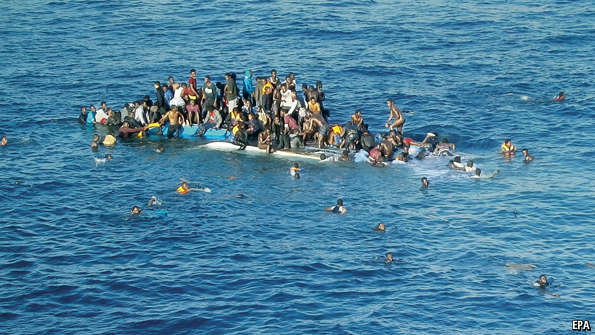
A Facebook page for Syrian refugees has now confirmed that his family has reached Italy. Asked about the danger they faced on the trip, Mr Albashawat replies, “What danger? This is nothing compared with the danger we saw in Syria.”
Angry tumult
The smuggling of people across the Mediterranean is not new; nor are the losses at sea that come with it. In 1996 at least 283 people died on an illegal voyage from Alexandria to Italy. But the TRADE
has vastly expanded over the past few years thanks to two developments.
The civil war in Syria has driven what the International Organisation for Migration (IOM) calls “the biggest movement of people since world war two”, with 8m people displaced inside the country and 4m leaving it. Most of these refugees stay in neighbouring countries. But many wish to go farther. In Turkey, which can be reached by ferry from Lebanon, they can join the flow of migrants from South Asia and Afghanistan, eventually entering Greece by boat. Alternatively they can head for Libya, either through Egypt or by flying to Sudan and joining one of the smuggling routes that cross the Sahara. There they will meet refugees fleeing Eritrea, a country which, with its mixture of indefinite military service, torture, arbitrary detention and all-round repression has one of the worst human-rights records in the world.
The routes head for Libya because another post-Arab-spring civil war has made it a much easier way to get to Europe. The smuggling routes which used to take people to Libya as an end in itself—moving there was for a time an attractive proposition for many in sub-Saharan Africa—now continue right through it and into the sea.
These two developments explain why the UN’s tally of migrants crossing the Mediterranean in 2014 was, at 219,000, nearly four times larger than the figure for the year before (see chart 1). Economic migrants like Mr Boubacar and refugees like Mr Albashawat can now frequently find themselves heading to sea together (though in all likelihood a wealthier Syrian like Mr Albashawat would be above decks and Mr Boubacar below).
But these developments do not, of themselves, explain why such people so often now end up dying together. The Italian government says 23,556 people had entered Italy irregularly by sea by April 19th this year, compared to 20,800 during the same period in 2014; the total number making the crossing, given the season, thus seems not to have risen year-on-year. But the number of migrants who have died has shot up. Even before the tragedy of April 19th, when a boat sank about 50 nautical miles (100km) off the Libyan coast, killing hundreds, this year’s tally of lives lost stood at 954, compared with just 96 to the end of April last year.
Exactly how many more died on April 19th is hard to say. The smugglers’ boat was in the process of being rescued by a Portuguese freighter when the two collided. One survivor has said 700 people were on board, another 950; other accounts put the number at around 400. What is known for sure is that the vessels which answered the distress call from the Portuguese ship were, between them, unable to find more than 28 survivors. “We stayed there for hours and hours, but all we found were jackets, rucksacks, caps and a big oil slick,” Vincenzo Bonomi, the skipper of a fishing boat told Il Fatto Quotidiano, an Italian newspaper. Just 24 bodies were recovered. Shock at the scale of the loss led to an emergency summit of European Union heads of government that was taking place on April 23rd as The Economist went to press.
Wild confusion
The obvious reason for the recent increase in deaths is that less is being done to avert them. In October 2013, after 366 migrants lost their lives off Lampedusa in another disaster, the Italian government launched an ambitious search-and-rescue operation, Mare Nostrum. It made use of an amphibious warship and two frigates, and had five naval vessels on patrol at all times as well as support from the coast guard. The navy claims the operation led to the rescue of more than 150,000 people and the arrest of 330 smugglers.
But a year after Mare Nostrum’s launch by the government of Enrico Letta it was shut down by Angelino Alfano, interior minister in Matteo Renzi’s new left-right coalition. Mr Alfano, who leads the New Centre Right, a conservative party, was in an uncomfortable position given the outright rejection of Mare Nostrum by the other parties of the Italian right. They complained that it had the effect of making the navy part of the smugglers’ business plan. The smugglers did not need to get their cargoes to shore, merely to abandon them where the ships of Mare Nostrum would pick them up.
The programme’s critics in Italy and elsewhere in the EU went on to argue that although it seemed to save people, by encouraging people to risk their lives it actually led to more deaths. As the British government put it, there was “an unintended ‘pull factor’, encouraging more migrants to attempt the dangerous sea crossing and thereby leading to more tragic and unnecessary deaths”.
When Mr Alfano, frustrated by the lack of support from the rest of the EU, closed down Mare Nostrum in October 2014 it was replaced with Operation Triton, run by Frontex, the EU’s border-control agency. Triton has fewer resources, less than a third of the budget and a narrower remit. Though its coastguard vessels have taken part in many rescues, they do not actively search for boats in distress more than 30 nautical miles from the Italian coast.
The unchanged numbers of migrants reaching Italy strongly suggest that making the crossing more dangerous has not reduced the pull factor at all. It is hard to say for sure that Mare Nostrum would have made a difference on April 19th; the smugglers’ boat might have sunk during the rescue even had the Italian navy been there. But the overall figures argue strongly that, by making the passage more risky, the move from Mare Nostrum to Triton has cost many innocent lives. “I just hope this latest mass killing will shake the consciences of the international community,” Italy’s coastguard commander, Vice-Admiral Felicio Angrisano, said on April 20th.
There may be some shaking. A ten-point EU response, outlined by home-affairs and foreign ministers on April 20th before the summit on the 23rd, reversed course to a degree. It promised to increase resources for Triton, though without explicitly mentioning search and rescue, the main feature distinguishing Triton from its predecessor. Donald Tusk, who as president of the European Council will chair the summit, declared: “The situation in the Mediterranean is dramatic. It cannot continue like this.”
It will, though, be very hard to change. The countries of the EU all have their own asylum systems; there is no mechanism for sharing refugees across the union. Under the so-called Dublin regulation it is the responsibility of the first European country that any asylum-seeker arrives in to have him fingerprinted and hear his application; if he is granted asylum, his right to remain applies only to that country.
Italy and other southern European countries argue that this places a disproportionate burden on them. Other countries retort that Italy often skirts that burden by neglecting to fingerprint applicants and letting them go where they will—which in practice means anywhere in the borderless Schengen area. Economic migrants know that, if at all possible, they should avoid getting fingerprinted and head north. Very few failed applicants for asylum get deported from Italy; a lot of economic migrants get in and move on, say other European countries.
So item five in the ministers’ ten-point plan demands a renewal of the commitment to fingerprinting of all migrants. The European Asylum Support Office will deploy teams to Italy and Greece to help them with the painstaking task of processing asylum applications. There will also be a “new return programme” to speed up the repatriation of boat people deemed to be illegal immigrants.
Appointed limits
Speeding things up is popular when it comes to refugees and asylum. In France Manuel Valls, the prime minister, has promised to slash the time it takes to resolve asylum applications. Germany’s interior minister, Thomas de Maizière, has argued for something similar. Both like the fact that rapid decisions can be pitched to the political left as helping refugees gain certainty, and to the right as helping deport those who do not deserve to stay. Taking into account the views of the anti-immigration right is seen as vital by most European governments.
That is why item six in the plan, which says that the EU will “consider options for an emergency relocation mechanism”—that is, a means of more fairly sharing refugees around Europe—is likely to be most contentious. The anti-immigration right wants to portray boat people as being for the most part illegal economic migrants, but a great many of them are not. Half of last year’s arrivals in Italy were from Syria and Eritrea (see chart 2) and, on an EU-wide basis, applicants from those countries got first-instance refugee status two-thirds of the time in the last quarter of 2014. A fair deal would need to parcel out tens or hundreds of thousands of Syrian and Eritrean refugees across the EU, and that will be hard to sell; some EU countries are a lot more welcoming than others (see chart 3).
That is why the EU’s focus is likely to be on dealing with what it wants to portray as the source of the problem—that is, not with its own arrangements and dysfunctional politics, but with the channels by which people get to its shores in the first place.
Co-operation with willing neighbours can produce results. And willing neighbours do not need to be nice ones. Italy used to do deals with Libya’s Colonel Muammar Qaddafi to shut off migration routes for a time, though he would periodically threaten to renege and send as many migrants as possible. These days, though, the writ of the internationally recognised government does not run over the ports where the migrants embark—Zawiya, Sabratha, Garabouli and Misrata. Officials from the rival administration in Tripoli, which is closer to those towns, OFFER
the help they might provide as a reason to give their faction recognition. “We know how much the Europeans worry about this,” says one. “If they don’t help us, we all suffer.” But Europe is not eager to recognise a motley bunch of militias, some of whom are Islamists.
There might still be unilateral options. The ten-point plan talks of sharing intelligence about people-smuggling networks, and in its promise to make “a systematic effort to capture and destroy vessels used by the smugglers” it even hints at military action. There is an allusion to an anti-piracy campaign, known as Operation Atalanta, in which EU helicopters strafed the boats and fuel dumps of Somali pirates. The prospect of EU countries taking such action in Libya, though, seems remote; they have not recently been much given to such poking at hornets’ nests.
If they were to do so there would be a risk that, like making the sea crossings more dangerous, such actions could end up hurting the people trying to migrate as much as, or more than, the people profiting from their migration. Part of the recent rise in the death toll may be due to the fact that the smugglers are already running short of boats and forcing ever more people onto the ones that remain. Twice this year, armed smugglers have taken back their vessels after a rescue operation—a sign that boats are becoming more valuable. As boats get scarcer, ever more people are forced onto each of them, often at gunpoint. Flavio Di Giacomo of the IOM says one recent arrival showed him scars on his arms and legs where he had been slashed with a knife to force him onto the boat.
Fire and foe
This is not the first brutality they will have faced on their journey. Some migrants are forced to work until they EARN
the smuggler’s fee, which invariably rises. Others are imprisoned in half-built houses or held in the desert until their families back home agree to pay ransoms. Just as ancient forms of networking co-ordinate smuggling trails across different countries, so modern networking allows a Libyan smuggler to get a Sudanese counterpart to collect payments from a migrant’s family in Khartoum. Many migrants are tortured, sometimes while on the phone with relatives for greater effect. Women face the additional risk of sexual violence.
The smuggling networks are highly lucrative. An Eritrean’s passage to Libya may cost $6,000, though a Malian might only pay a tenth of that. The UN says shipping migrants towards Europe from Libya is a $170m industry. The smugglers combine criminality and tribal loyalty and are very adaptable to changes in circumstance. So although better-shared intelligence on the part of the EU and local states may get some results, it is highly unlikely to shut the TRADE
down. Control of Libya’s ports could do more, though it would leave the problem of more than 500,000 would-be migrants stuck in a country that does not want them and with no way back home.
And if the situation in Libya were tightened up, new routes would emerge. Not that long ago the main route for Africa’s economic migrants was across the Atlantic to Spain’s Canary islands; at other times the boat people set out mainly across the Aegean Sea to Greece. When the regime of Zine el-Abidine Ben Ali collapsed in 2011 migrants set forth en masse from Tunisia.
Thus the EU is also looking at the possibility of processing claims to refugee status outside the EU—either in north Africa or in the countries Syrians first enter on leaving their own. There is talk of an EU “pilot project” to resettle about 5,000 Mediterranean refugees. It would require a process for selecting beneficiaries and for choosing where in the EU to send them on the basis of some sort of “distribution key” based on size of population, economic strength, unemployment rates and the number of refugees already taken in. This might be the start of greater harmonisation in EU asylum policy.
Mr de Maizière has proposed establishing centres in north Africa to review asylum applications at the source—another policy that can be presented as tough or generous, depending on the audience. Having a base beyond your shores at which to do such things has been tried by others: America lands refugees from Haiti and elsewhere at its Guantánamo Bay base on Cuba; Australia takes them to the island-state of Nauru and to Manus island in Papua New Guinea, never letting them onto its own soil. Australia has diverted hundreds of boats in recent years; only one has even entered its territorial waters since the end of 2013. But the tough policy has come at a great cost to the country’s reputation (see article).
Besides, Europe lacks a convenient island nation open to aid-for-boat-people inducements. And its law adds protections for refugees beyond those that American and Australian lawyers claim to see in the 1951 UN convention. In 2012 the European Court of Human Rights ruled that boat people must be given a fair chance to apply for asylum and may not automatically be sent back even if rescued in international waters.
A processing centre in north Africa might deal both with migrants reaching it over land and with those saved from the seas, should it meet the court’s criteria. It would, though, require a stable regime to host it, and might very easily become a target for terrorism. And it—or they—would attract vast numbers of migrants from elsewhere in Africa.
In the case of the last great maritime refugee crisis, that of the Vietnamese boat people, it took concerted measures by many countries to get to grips with the problem. More than 1m people were resettled around the world; merchant ships were compensated for their rescue efforts; eventually deals were struck with Vietnam for the orderly departure of refugees and the repatriation of the undeserving. For the world to help Europe in such an effort when Europe has, so far, shown no real ambition in sorting out the issue itself, though, would seem far-fetched.
And in the long run migration north to Europe will never just be a matter of refugees. Though chaos and civil war are hardly likely to leave the Arab world soon, chronic underdevelopment and accompanying political instability in parts of sub-Saharan Africa look set to last even longer. And the population there is expected to double over the next 30 years. There will be a lot more young men like Mr Boubacar.
There are many worse places to live than Bamako. It is a reasonably sophisticated city; Mali’s economy grew 7.2% last year. But Mr Boubacar wants out. “No matter how hard I work, I’m doomed. My father did not have a regular salary, I don’t, nor will my children.” No job lasts longer than a few months, no place in school is assured, no gain is safe from theft. Economic ANXIETY
is mixed with fear of political violence. Half of Mali fell to Islamic extremists three years ago. A French-led intervention pushed them back, but no peace deal has been signed, and terror attacks remain common. And Mali is far from the only country in the region to be threatened by political instability—or, for that matter, by climate change, which could lay low economies and governments. The forces that move a man to economic migration today could make him a refugee tomorrow.
And all the time pictures of seemingly attainable prosperity glisten on the television screen in the back of Mr Boubacar’s café. The vision can seem like a mirage, but everyone knows someone who can attest to its reality. A man sitting outside the café says he has heard of several people who have made it all the way to Europe and sent back glowing reports. But he also knows that they are the lucky ones. “The ones who die we never hear from. They can give no advice.”
Subscribe to:
Posts (Atom)


