Monday, 3 March 2014

Ukraine and the “Politics of Anti-Semitism”

Ukraine and the “Politics of Anti-Semitism”: The West Upholds Neo-Nazi Repression of Ukraine’s Jewish Community

By Prof Michel Chossudovsky            Global Research, February 26, 2014

neonazis ukraine
The US and the  EU are supporting the formation of  a coalition government integrated by Neo-Nazis which are directly involved in the repression of the Ukrainian Jewish community. 
There are about 200,000 Jews living in Ukraine, most of them in Kiev. This community is described as “one of the most vibrant Jewish communities in the world, with dozens of active Jewish organizations and institutions”. A significant part of this community is made up of family members of holocaust survivors. “Three million Ukrainians were murdered by the Nazis during their occupation of Ukraine, including 900,000 Jews.” (indybay.org, January 29, 2014).
Ukrainian Jews were the target of the Third Reich’s Einsatzgruppen (Task Groups or Deployment Groups) which were supported by Ukrainian Nazi collaborators (Wikipedia). These “task forces” were paramilitary death squads deployed in occupied territories.
Contemporary Neo-Nazi Threat against Ukraine’s Jewish community
While the Western media has not covered the issue, the contemporary Neo-Nazi threat against the Jewish community in the Ukraine is real. Ukrainian Neo-Nazis pay tribute to Stepan Bandera, a World War II-era Nazi collaborator who led the pro-Nazi Organization of Ukrainian Nationalists (OUN-B). The contemporary Neo-Nazi Svoboda Party which is supported by Washington follows in the footsteps of the OUN-B.
Reuters / Gleb Garanich
Neo-Nazis Honoring Stepan Bandera
Reports from Kiev confirm that the Jewish community is the target of the Right Sector and the Neo-Nazi Svoboda party, which is supported and financed through various channels by Washington and Brussels:
“Ukrainian Rabbi Moshe Reuven Azman asked Kiev Jews to leave the city and, if possible, the country, due to fears that Jews might be targeted [by Svoboda Brown Shirts] in the ongoing chaos. … Some Jewish shops have been vandalized and other threats to the Jewish community have been received.
“I told my congregation to leave the city center or the city all together and if possible the country too… I don’t want to tempt fate…but there are constant warnings concerning intentions to attack Jewish institutions,” Rabbi Azman told Maariv. (JN, February 24, 2014)
The leaders of the Ukrainian Jewish Community contacted Israel’s Foreign Minister Avigdor Lieberman requesting the assistance of Israel. (Edward Dolinsky, head of the umbrella organization of Ukraine’s Jews).
Israel –which is unofficially a member of the Western military alliance (US-NATO-Israel)– has remained mum on the subject: Real Politik Uber Alles. No statement has emanated from Tel Aviv.  The Israeli government has not responded to the request of the Ukrainian Jewish Community nor has it made any statements.
America’s pro-Israeli lobby The American Israel Public Affairs Committee (AIPAC) has not taken a stance on the issue. Not a word from Israel’s Prime Minister Netanyahu.
The Western Media: Talking about the Neo-Nazi Threat to Ukraine’s Jewish Community is Taboo
Within the Western media, news coverage of the Neo-Nazi threat to the Jewish community in Ukraine is a taboo. There is a complete media blackout: confirmed by Google News search, mainstream coverage of the threat to the Jewish community in Ukraine is virtually absent.
An article in the current issue of The New York Review of Books constitutes the pinnacle of falsehood and media distortion. The Jewish community in Ukraine is portrayed as an unbending supporter of the Maidan protest movement led by Right Sector Neo-Nazis:
The protesters represent every group of Ukrainian citizens: Russian speakers and Ukrainian speakers (although most Ukrainians are bilingual), people from the cities and the countryside, people from all regions of the country, members of all political parties, the young and the old, Christians, Muslims, and Jews. Every major Christian denomination is represented by believers and most of them by clergy. The Crimean Tatars march in impressive numbers, and Jewish leaders have made a point of supporting the movement.
In its broader coverage of the Ukraine “protest movement”, the Western media has failed to acknowledge the nature of the opposition, casually referring to “radical elements”.
What is not mentioned is that these “radical elements” supported and financed by the West are Neo-Nazis who are waging a hate campaign against Ukraine’s Jewish community.
Reunion of SS and UPA Nazi collaborators and their supporters in 2006 in the Ukraine. Civilisation Ukrainian-Style: Vandalising the Memorials to the Soldiers of the Anti-Hitler Coalition
The Israeli Media and the State of Israel
The Israeli media toes the line. The hate campaign against the Ukrainian Jewish community is not the object of concern. The Jerusalem Post casually dismisses the evidence of crimes committed against Ukraine’s Jewish community under the title:
“Although there is “no information of Jews being targeted” as of yet, Jewish institutions are under self-imposed lock-down”.
According to the JP, there is no “defined threat against them”:
“There is currently “no information of Jews being targeted, but there is a danger because of vigilante groups,” Chief Rabbi Yaakov Bleich told The Jerusalem Post on Sunday.
“We have not seen any random attacks and we hope people are basically interested in law and order and not in mayhem,” he said, expressing his hope that protesters would begin turning in their arms tomorrow as scheduled.
“We are definitely worried about security and everybody should keep their guard up,” the American-born rabbi cautioned. “That’s because of the general situation. There are no threats that we know of.”
… There is a great deal of uncertainty among Kiev’s Jews, said one community member, speaking anonymously.She said that while there has been no direct threat against Jewish institutions, two Jews were attacked during the protests and the general feeling of insecurity pervading the city has affected its Jews as well.
Things will calm down within a week, but life is still far from normal at the moment, she said.” (Ukraine’s Jews ponder their future, Jerusalem Post-Feb 24, 2014)
According to “expert opinion” quoted by the JP, the spread of swastikas in Kiev’s urban landscape should be of no concern. According to Vyacheslav Likhachev, “an expert on the far-right associated with the Euro-Asian Jewish Congress”, the Svoboda Neo-Nazi activists are not attacking Jews. In an utterly twisted logic expert Likhachev quoted by the JP intimates that the (former) Yanukovych government is responsible for anti-semitic violence;
The two incidents of anti-Semitic violence since the beginning of the protests, he alleged, were most likely provocations by the government looking for a pretext to clamp down on its political opponents.
“There is no real special danger for the Jewish community due to anti-Semitism from protesters,” he said.
According to Likhachev, the authorities tried to recruit him to take part in apropaganda campaign against the protesters and he believes that, given the lack of emphasis placed on Jews and other ethnic minorities by the opposition,including such factions as Svoboda, it is more likely that the attacks were part of this alleged campaign. (Ibid)
According to the JP, the issue is one of “transition”, which will be resolved once a new government is installed .
“Despite his [Likhashov's] optimism fear pervades the local Jewish community, as it does the entire Ukraine, during the transition period.”
Ironically, while the Israeli media dismisses the matter, the Arab media has provided a far more balanced assessment of the threat to the Jewish community in Ukraine.
Rabbis in Kiev and across Ukraine spoke out, warning their congregations to stay off the streets and remain in their homes. The Jewish Agency in Jerusalem has moved swiftly to offer aid to elderly Jews living in greater Kiev. Food-delivery men are braving gunshots and Molotov cocktails to help them. Reports from Kiev say the police have been replaced by roving bands of undetermined loyalty.
… The fresh report of the firebombing of a new synagogue in Zaporizhia, 250 miles southeast of Kiev, increased the alarm in Israel and accelerated planning for all contingencies, including evacuations. (John Batchelor, Ultranationalist neo-Nazi parties on the march in Ukraine, Al Jazeera, February 25, 2014
Neo-Nazi Svoboda Party Oleh Tyahnybok. Below with US Assistant Secretary of State Victoria Nuland
nuland in ukraine
US Assistant Secretary of State Victoria Nuland together with Neo Nazi Svoboda leader Oleh Tyahnybok, left
The Politics of Anti-Semitism:  Anti-Semitism Practiced at a Political Level
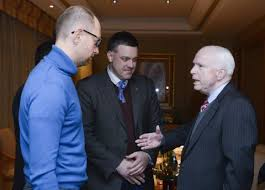
Ironically, while renowned scholars critical of the State of Israel for violating the fundamental rights of Palestinians are accused of being “anti-semitic”, nobody bats an eye lid when John McCain (see image right with the leader of the Neo-Nazi Svoboda Party Oleh Tyahnybok, centre),Victoria Nuland (image above together with Oleh Tyahnybok, left), EU foreign policy chief Catherine Ashton (also with Oleh Tyahnybok, left), John Kerry, Francois Hollande and Angela Merkel (among others) openly pay lip service to Neo-Nazism in the Ukraine.
Is the Western media “anti-semitic” when it fails to report crimes committed against the Jewish population in Ukraine?
Is the self-proclaimed “international community” anti-semitic when it upholds in the name of “democracy” a “protest movement” led by Neo-Nazis?
Is Netanyahu an anti-semite by tacitly supporting  US-EU-NATO geopolitical interests in Ukraine, with total disregard to the rising tide of fascism and anti-semitism?

Wednesday, 26 February 2014

The Road to Moscow Goes Through Kiev: A Coup d’Etat That Threatens Russia

The Road to Moscow Goes Through Kiev: A Coup d’Etat That Threatens Russia

By Mahdi Darius Nazemroaya
Global Research, February 25, 2014

Euromaidan Riots

The takeover of power in Kiev by the mainstream opposition is a coup that has been executed by

force, which overlooks the opinions of at least half of the Ukrainian population. Yet, you would not

know this from listening to such media outlets and networks as CNN or Fox News or reading the

headlines being produced by Reuters and the state-owned British Broadcasting Corporation

(BBC). The events in Kiev are misleadingly being billed and framed by these media sources and

the so-called “Western” governments they support, either directly or indirectly, as the triumph of

people power and democracy in Ukraine.


Utter hypocrisy is at work. When similar protests and riots broke out in Britain and France, the

positions taken and the tones used by the above actors was very different. These actors framed

the protests and riots in Britain and France as issues of law and order, using language very

favourable to the British and French governments. Where were the statements of concern about

the rights and safety of protesters from the US government and the European Commission when

force was used by the British and French governments or when protesters died?

While not overlooking, disregarding, or devaluing the loss of life in Kiev, the roots of the violence

there need to be discussed honestly and traced back. On the same note, it has to be understood

that members of the Ukrainian opposition and their supporters were agitating for a violent

confrontation against the Ukrainian government. There is no argument here against the right of

citizens to protest, but rioting or taking up arms with the intent to oust a democratically-elected

government is a different matter that no government in the US or the EU would accept on their own

territory.


When the laws that the US and EU countries have in place are quickly glimpsed at, gross

double-standards are evident. Universally, the criminal codes of these governments forbid the

assembly of their citizens for the purpose of discussing the overthrow of the government alone.

Their criminal codes consider whoever advocates, aids, advises, or preaches for the

overthrowing or the government by political subversion as a criminal and threat to the state. In the

US “anyone  with intent to cause the overthrow or destruction of any such government, prints,

publishes, edits, issues, circulates, sells, distributes, or publicly displays any written or printed

matter advocating, advising, or teaching the duty, necessity, desirability, or propriety of

overthrowing or destroying any government in the United States by force or violence, or attempts

to do so” is considered a felon under the criminal code. If two or more persons even meet to talk

about removing the government in most these countries, they can be imprisoned. In the case of

the United States, as the US Criminal Code states, these individuals “shall be fined under this title

or imprisoned not more than twenty years, or both, and shall be ineligible for employment by the

United States or any department or agency thereof, for the five years next following his

conviction.”


Washington and the European Union have aided and encouraged the above acts by openly

supporting the campaign of the Ukrainian opposition and even sending officials and politicians to

encourage the anti-government forces in Ukraine. The irony is that this is the exact type of

behaviour that the US and the European Union have outlawed on their own territories and would

not tolerate against themselves whatsoever.


If it were merely a case of ethnocentrisim, this attitude could be called exceptionalism. It,

however, is not exceptionalism. To be very candid, it is heartless regime change perpetrated by

governments that have a record of insincerely hiding behind democracy and humanitarianism.


How the European Union Enabled the Coup

What has taken place in Kiev is a coup that has unfolded through the manipulation of the emotions

and hopes of a significant segment of the Ukrainian population by opposition leaders.  It has to be

emphasized that many opposition supporters are doing what they believe is right for their country

and that they themselves are the victims of their own corrupt leaders. It must equally be

emphasized, regardless of which side they support, that the Ukrainian people are all the victims of

their corrupt politicians. Both the governing party and opposition parties have taken turns ruling the

country and exploiting Ukraine for their personal gains.


The opposition leadership has basically usurped power while the European Union and the United

States have given their full support to them. This has been done via EU and US attempts to

legitimize the opposition power grab through the portrayal of the coup in Kiev as the climax of a

popular revolution in Ukraine.


Albeit the mainstream opposition is not truly united, opposition leaders have grossly refused to

fulfill any of their obligations after an agreement was brokered between them and the Ukrainian

government by the European Union through mediation by the troika of France, Germany, and

Poland. The Ukrainian government and Russia have rightly accused the European Union and the

EU mediators of refusing to fulfill their obligations to make sure that the opposition respects the

EU-brokered agreement.  Instead the European Union has allowed Ukrainian opposition leaders

to ignore their commitments and to grossly violate the agreement.


While one faction of the opposition was negotiating another faction of the opposition continued the

pressure from the streets, refusing to stop until the government was ousted. The agreement

signed between the Ukrainian government and the mainstream opposition on February 21, 2014

had no clause or terms, however, that granted the opposition the rights or power to take over the

executive, legislative, and judicial branches of Ukraine or to unilaterally create new legislation.

Any information that implies that the agreement allows for this to take place is false and

misleading.


Instead the agreement has been used as a disguise for the opposition’s takeover of the state. In

truth, the European Union helped broker the agreement as a means of empowering the Ukrainian

opposition. The leaked phone conversation about the protests in Ukraine between the US

Department of State’s Victoria Nuland and Ambassador Geoffrey Pyatt, the US ambassador in

Kiev, even indicated that the US and EU were planning on creating a new government in Ukraine.

The Nuland tape reveals that Washington was working to inaugurate a new opposition-led

government in Ukraine with Ukrainian figures that would readily submit and acquiesce to US and

EU demands.


What Nuland and Pyatt discussed is regime change in Ukraine, which has nothing to do with what

the Ukrainian people want and everything to do with what the US government and its allies need

from Ukraine. If the US government really believed that the Ukrainian people have the right to

determine their future, it would not be busy working to appoint political figures in the Ukrainian

government or trying to configure how the Ukrainian government would be constructed. Instead

Washington would leave the creation of government in Kiev to the Ukrainian people.

Using Parliamentary Camouflage in the Rada to Disguise a Coup

The leaders of the opposition are trying to cosmetically deceive Ukrainians and the world by

hijacking the legislative branch of their country’s government. There are strong chances that this is

being done with the coordination and the encouragement of the US government and the European

Union. To legitimize their takeover, the Ukrainian opposition is now using the Ukrainian Parliament

or Verkhovna Rada. The Rada was already a heavily corrupt place with notoriously crooked and

dishonest politicians dominating both the pro-government and opposition sides of the aisle, now it

is functioning as a rubber stamp legislature. In other words, the Ukrainian opposition leadership is

trying to legitimize its coup in Kiev by using the dysfunctional Ukrainian Rada.

The Rada has not been at full decorum for all the voting. The opposition initially used the instability

and fleeing of the government to opportunistically declare its unchallenged Rada bills as

legitimate. This happened while approximately half of Ukraine’s parliamentarians were either

absent or in hiding due to the violence and riots in Kiev. In other words, opposition leaders used

the absence of about half the parliamentarians in the Rada to falsely give a cover of legality to their

coup by taking the opportunity to pass parliamentary legislation that would be defeated if all the

Rada’s members were present and voting.


Albeit under the management of the opposition the Rada has retained a sufficient amount of

parliamentarians or deputies to hold an emergency session, there are serious ethical, procedural,

technical, legal, and constitutional questions about what is taking place. To hold an emergency

session, the Rada needs at least two hundred and twenty-six of its parliamentarians to be present.

 Under opposition management there were initially two hundred and thirty-nine deputies, but this

did not entitle the opposition to pass any type of legislature that it pleased or to pretend that the

Rada was operating under a regular constitutional session. Moreover, there were important and

specific procedures that still needed to be followed that the opposition parties outright ignored

and violated.


Ukraine’s biggest political party, the Party of Regions, and the other pro-government parties or

independent parliamentarians have not been present for all the Rada votes taking place. Albeit an

increasing number of pro-government deputies are now beginning to negotiate with the opposition

and a faction of the deputies from the Party of Regions have returned to the Rada to protect

themselves, the absence of many of the Rada’s deputies and the fact that all Ukrainian

parliamentarians are not inside the Rada to challenge the opposition bills makes, at the very least,

the legislation that has been passed questionable. Examining other factors, the laws being

passed in the Rada become even more questionable.


The Rada’s chairman (speaker or president), Volodymyr Rybak, has not been present for the

reading of Rada bills either. It has been reported that Rybak has resigned from his Rada post. Not

only must the individual that has been elected as Rada chairperson by a full constitutional session

of the Rada be present for the voting process to be legitimate, but the Rada chairperson must

also approve the acts adopted by the Rada with their signature before they are sent to the

executive branch of government for promulgation. Nor can Ukrainian bills be passed into law or

promulgated after the Rada votes without a final presidential signature. The only way that a

presidential veto can be overturned is if two-thirds of the Rada’s deputies or members support a

bill after the presidential veto, in which case either the president must sign it or the Rada’s

chairperson signs the bill into law.


The opposition has tried to circumvent the necessary presidential approval and the absence of a

Rada chairperson. Instead opposition leaders got their parties to unilaterally select a new

chairman, Oleksandr Turchynov, so that they can push their political agenda forward without getting

challenged. Turchynov’s appointment as Rada chairman was meant to give the Ukrainian

opposition’s parliamentary work the cover of legitimacy. The opposition appointed Turchynov to

claim that constitutional procedures have been followed, because a Rada chairperson has been

overseeing their partisan bills and approving them. Moreover, Oleksandr Turchynov is not only

overseeing and approving the unilateral bills of the Ukrainian opposition, but has signed them into

law as the acting president of Ukraine too.


What the opposition has done with Turchynov, however, is illegal for a number of reasons. Firstly,

most of the Rada, meaning all the deputies or members of the Ukrainian Parliament, must

convene before a new Rada chairman or speaker is selected to oversee parliamentary voting on

bills. This did not taken place, because many of the Rada’s members were missing when he was

selected. Secondly, Turchynov cannot assume the role of Rada chairperson if there is already a

chairperson with a first vice-chairperson (first deputy chairperson) or assume the role of acting

president until President Viktor Yanukovych resigns or is impeached by the Rada, which did not

take place when he was declared acting president.


Using divisions inside the bewildered Party of Regions hierarchy, the opposition has sought to

cover its unconstitutional tracks. Days after Turchynov was appointed chairman of the Rada, the

opposition got a faction of the Party of Regions deputies that returned to the Rada and a series of

independent Rada deputies to impeach President Yanukovych. These Party of Regions and

independent parliamentarians are working with the opposition in order to keep their places or to

secure positions for themselves under the new political regime in Kiev.


The Rada is now a rubber stamp body controlled by the opposition. It has already acted illicitly.

Although there is still uncertainty or arguments on whether the 2004 version or 2010 version of the

Ukrainian Constitution is in operation, Article 82 of the Ukrainian Constitution (regardless of

whichever version is in operation) stipulates that the Rada is only “competent on the condition that

no less than two-thirds of its constitutional composition has been elected.”


Discussions have also taken place about new media regulations and expelling the Russian media

from Ukraine. Exposing just how fake their democratic leanings are, the opposition leadership has

threatened to use the Rada to additionally outlaw any of the political parties in Ukraine that have

opposed them. This includes banning Viktor Yanukovych’s Party of Regions.

The Party of Regions is not only the most widely supported Ukrainian political party; it also holds

nearly forty percent of the seats in the Rada. No other political party even comes close to holding

this type of support in the Ukrainian political landscape or the Rada. Excluding the parliamentary

seats of its political allies in the unicameral Rada, which houses four hundred and forty-two seats in

total, the Party of Regions alone has one hundred and sixty-five seats. The opposition political

parties and coalitions comprised of the All-Ukrainian Union Fatherland (Batkivshchyna), the

Ukrainian Democratic Alliance for Reform, and Svoboda have a combined one hundred and

sixty-seven seats. There is no question about which party the majority of Ukrainian voters support.

Outlawing the Party of Regions essentially annuls the electoral choice of the most significant

plurality of Ukrainians.


Opposition leaders also want to illicitly use the Rada to outlaw the Ukrainian Communist Party. The

Ukrainian Communist Party has called the so-called EuroMaidan/Euromaidan protests a foreign-

sponsored coup against Ukraine and its people. The opposition threats about banning the

Ukrainian Communist Party, and even killing its members in the streets, is meant to punish it for

the position it has taken and for the support it has given to the Ukrainian government against the

anti-government protests in Kiev.

The Balkanization of Ukraine? Is Ukraine to follow Yugoslavia’s Path?


It seems that maybe the worst is yet to come. Is Ukraine destined to go the way of the former

Yugoslavia? The question is being entertained more and more seriously. Andrei Vorobyov, a

Russian diplomat in Kiev, even commented, much to the angst of the Ukrainian government, that

federalization may be the best solution for Ukraine and that Ukraine was already in a de facto

federal state. The reasons behind the angst about the federalization comments are the increasing

anxieties of Ukrainian authorities and citizens about the possibility that their country could divide or

fragment.


Before the opposition takeover of Kiev in February 2014, Ukraine was already a polarized country

and society. The western portion of Ukraine has been under the influence and control of the

mainstream opposition whereas the eastern and southern portions have been under the influence

and control of the Party of Regions and its political allies. The opposition’s actions outside of the

framework of democracy have opened the door for lawlessness and a devolution of governmental

power.


Different areas of Ukraine have fallen into the hands of opposition militias. The militia of Aleksandr

Muzychko, one of the ultra-nationalist opposition leaders and a fervent opponent of Russia that

fought alongside Chechen separatists in Grozny against the Russian military, now control different

towns in the western portion of Ukraine. They have threatened to wage war against the Ukrainian

government using tanks and heavy weaponry.


Political machinations from all sides are at work too. After the opposition takeover, officials from

President Yanukovych’s own Party of Regions laid responsibility for the deaths in Kiev squarely

on his shoulder and condemned him as a coward and traitor to Ukraine, virtually ignoring the role

that opposition leaders played in igniting the political crisis and the loss of life. Fearing the violent

segments of the opposition, the Party of Regions has additionally condemned the mainstream

opposition’s intimidation campaign and threats of violence against the Party of Regions and its

supporters.


There are Rada deputies or parliamentarians from the Party of Regions that are now in the eastern

and southern portions of Ukraine and afraid to return to Kiev due to the violent opposition militias

that have taken over. There are reports that a parallel parliament may be established somewhere

in eastern or southern Ukraine, which would effectively divide the country like Bosnia was divided

when the Bosnian Serbs created their own parallel parliament after the Bosnian Parliament in

Sarajevo ignored Bosnia’s communitarian formula that essentially guaranteed a veto to Bosnia’s

Bosniak, Croat, and Serb communities as a means of maintaining co-existence.


The silent or unheard of half of Ukraine, which the mainstream media in the US and the EU refuse

to acknowledge, is now bracing itself and preparing for an expansion of the violence in Kiev. It

fears the spread of violence being perpetrated by the militant segment of the opposition. The

violence has already begun to touch Kharkiv. There are now calls for secession from the

predominately-Russophone Crimean Peninsula, which wants to annul the Soviet era decision of

Nikita Khrushchev to detach the Crimean Peninsula from Soviet Russia as an award to Soviet

Ukraine that symbolizes unity and kinship between Russia and Ukraine.


If the Crimean Peninsula should separate, there are suggestions that Russia could intervene

militarily in the Crimean Peninsula. If this was to happen, it would take place through an invitation

by Crimean officials and the Autonomous Rada (Duma or Parliament) of the Crimea, which in June

2006 even created anti-NATO legislation banning North Atlantic Treaty Organization (NATO) forces

from entering Crimean territory while its officials called Viktor Yushchenko, the pro-NATO president

of Ukraine, a puppet of the US and the EU. The concern about Russian intervention has even

been addressed with an ironically hypocritical and indirect warning from Susan Rice to the Kremlin

not to sent troops into Ukraine.


The Autonomous Republic of the Crimea in the Crimean Peninsula, which is the historical home of

Ukraine’s Muslim minority, is not the only place in Ukraine that has threatened to take action as a

result of the coup in Kiev. As a precautionary reaction to the violent and armed segments of the

Ukrainian opposition that have destabilized Kiev, counter-militias are now being formed in places

like the oblasts of Kharkiv and Donetsk in the eastern and southern portions of Ukraine. Officials

and Ukrainians from these eastern and southern parts of Ukraine have also said that they do not

recognize the Rada in Kiev as legitimate any longer and that the legislation being passed by it is

illegal and void.


Ukraine’s polarized politics also overlap with the contours of organized religion. While the majority

of Ukrainians are Christians that belong to the Russian Orthodox Church of Ukraine (simply called

the Ukrainian Orthodox Church), there is also a division among them that is linked to nationalist

politics. About half the followers of the Ukrainian Orthodox Church look to Patriarch Kirill in Moscow

as their patriarch and as the supreme primate of the Ukrainian Orthodox Church, but the other half

belongs to the breakaway portion of the Ukrainian Orthodox Church that follows Patriarch Filaret in

Kiev. At least in nominal terms, ultra-nationalists and opposition supporters mostly follow the Kiev

Patriarchate and those supporting the Party of Regions generally look to Moscow as their spiritual

centre. These divisions have the potential of being manipulated in a Yugoslavia-style scenario.

The picture gets more complicated when the minority faiths in Ukraine are examined. Ukrainian

Catholics, both the Unites of the Greek Catholic Church and the Roman Catholics, generally seem

to favour the opposition and integration with the EU too. There has actually been growing

resentment towards the Ukrainian Catholics, who are viewed as Polish agents, by members of the

Ukrainian Orthodox Church.  Despite the well-known and advertised dislike of Jews by a segment

of opposition supporters (similar negative views about Jews, which have historically existed in

Ukraine, also exist among some government supporters), Ukrainian Jews are divided between

the pro-government and anti-government camps. According to the Jerusalem Post and the Jewish

Telegraphic Agency, Ukrainian Jews have taken part in the anti-government protests alongside

Ukrainian ultra-nationalists. Ukrainian Muslims, three-fifths of which are Crimean Tartars, on the other

hand seem to generally support the pro-government side, albeit there is Muslim support for

opposition parties. Ukrainian Muslims, however, are cautious and do not support the dissolution of

Ukraine or separatist feelings that exist among the Russian community.

The Blurred Lines that Exist between Ukrainians and Russians

The Eastern European country’s politics are even more complicated by the fact that the Russian

language is prevalent in the eastern and southern sections of Ukraine. There is an ongoing

dispute about the exact numbers. Due to the closeness of both the Russian and Ukrainian

languages, in some parts of Ukraine it is hard to identify if the local population is actually speaking

a dialect of the Ukrainian language or the Russian language. Even more confounding, the lines

between Ukrainian and Russian identity and language are not clear cut.


Aside from the blurred language lines and the fact that both Ukrainian and Russian were once one

language, there is a blurred line on who is ethnically Ukrainian and who is ethnically Russian.

Approximately thirty percent of Ukrainians consider Russian as either their first or mother language

and are Russophones according to the Ukrainian government, but only about half of these

Russophone Ukrainian citizens are actually ethnically Russkiye (ethnic Russian). Sociological work

conducted in 2004 asserts that the number of Russophones is actually much higher and that

Russian and Ukrainian are actually used almost equally.


There is even a minority of ethnic Russians that speak Ukrainian as their first language and a much

larger minority of ethnic Ukrainians that speak Russian as their first language. Many Ukrainian

citizens are also bilingual and there is also a preference for using Russian as a daily language

and business language in many parts of Ukraine. As part of a historical and sociological process,

ethnic Ukrainians have adopted the identity of ethnic Russians and vice-versa, ethnic Russians

have adopted identities as ethnic Ukrainians. When asked, many Ukrainian citizens are not even

sure if they are Russkiye or ethnic Ukrainian.


If anything is to be remembered about the causes of the First World War and the Second World

War, it should be that nationalism and feelings of exceptionalism were used like opiates to

captivate and manipulate ordinary citizens into supporting war and the rise of opportunists. The

Ukrainian opposition leadership has deliberately promoted and nurtured ultra-nationalist

sentiments to blind and manipulate its followers. Ukrainian nationalism, specifically the Western-

leaning pro-European Union type, has been formulated on the unhealthy basis of anti-Russian

sentiments and a distorted notion of the cultural superiority of the European Union and the cultural

inferiority of the Eastern Slavs (particularly Russians, but including Ukrainians and Belarusians).

It is the multiple convergences between Ukrainians and Russians and the complex relationship

between the Ukrainian and Russian identities that make the decidedly anti-Russian attitudes of the

mainstream opposition, some of which openly glorify Adolph Hitler and the Third Reich and its

invasion of the Soviet Union, so dangerous for solidarity in Ukrainian society and Kiev’s future

relations with Russia and the other countries bordering Ukraine.

Revolution for Democracy or Riots Promoting Subversion to the European Union?

The crisis in Ukraine did not take place, because the Ukrainian government was corrupt or used

force against the protesters in Kiev’s Independence Square. It started, because the Ukrainian

government refused to sign the European Union’s EU-Ukraine Association Agreement in

November 2013. This is why the violence in Kiev has not only unreservedly been given political

cover from the political establishment in the United States and the European Union to

internationally give it public legitimacy, but has also received media support in the form of biased

reporting that favours the opposition.


Social media has been saturated by advertisements and questionable grassroots videos and

footage, like the professionally-produced Council for Foreign Relations-linked “I Am a Ukrainian”

YouTube video, that paints a distorted narrative of the reasons behind the anti-government riots.

Like the other propaganda ignoring the reasons behind the anti-government protests, the “I Am a

Ukrainian” video totally ignores the fact that the protests in Kiev did not start on the basis of

democratic demands, but started due to the Ukrainian government’s refusal to sign an agreement

with the European Union.

Actually, the Ukrainian government and the Party of Regions were initially very supportive of the

association agreement with the European Union, but backed out after the EU refused to

renegotiate the agreement or to give financial guarantees and economic relief to Kiev for the trade

losses and higher gas prices that Ukraine would face as a result of signing the agreement.

Moreover, the Ukrainian oligarchs aligned to President Yanukovich and his Party of Regions

realized that the agreement would allow corporations from the European Union to dismantle their

own corporations and to replace their monopolies with EU corporate monopolies and control. The

EU agreement would force Ukraine to change many of its trade laws and regulations that would

disadvantage the Ukrainian oligarch’s corporations and, in economic terms, allow for Ukraine to be

gutted and essentially reduced to an Eastern European colony.


The Ukrainian government did not sign the EU agreement because it is pro-Russian. Albeit the

Party of Regions politically caters to Ukrainians that view Russia favourable, anyone that says or

thinks that the leadership in the Party of Regions is pro-Russian or that the Party of Regions is a

pro-Russian political party is grossly misinformed or lying. For many years the leadership of the

Party of Regions has even openly said that they are not hostile to NATO and Viktor Yanukovych,

in the role of prime minister, himself even implemented the NATO integration policies that

President Leonid Kuchma was pursuing. The Ukrainian government did not sign the European

Union’s EU-Ukraine Association Agreement  because of its own interests and not on the basis of

favourable sentiments towards Russia.


If the deal only targeted the Ukrainian economy without challenging the monopolies and privileges

of the Ukrainian oligarchs, President Yanukovich and the Ukrainian government would have

signed it without any hesitation. The EU deal, however, was simply unfeasible and suicidal for both

the Ukrainian oligarchs and the economy. The agreement with the EU additionally would force

Ukraine to cut its trade ties with its major economic partners, Russia and the other members of the

Commonwealth of Independent States (CIS), without providing any alternative. It would have

politically hurt the Party of Regions in the future too.

The Euro-Atlantic Drive into Eurasia: Using Kiev to Target Russia and Beyond… 

The US and EU support for the Ukrainian opposition, even if in part, is aimed at bringing Ukraine

into their orbit and to encircle, isolate, and eventual subvert the Russian Federation. Resurgent

Orangists and a new coalition of opposition figures have formed a new front, which can be called a

neo-Orangist front, which is intensely intent on shifting Ukraine into the Euro-Atlantic orbit of

Washington and the European Commission through eventual membership in such institutions and

supranational structures as NATO and the European Union.


These opposition politicians made a mess of things after the Orange Revolution when they ran

Ukraine earlier. It remains to be seen if they can re-orient Ukraine into the Euro-Atlantic zone (the

word “Euro-Atlantic” camouflages the role that the US plays in Europe; more properly it should be

called the Euro-American zone). When mainstream opposition leaders were ruling Ukraine, they

were too busy embezzling and fighting one another to further the goals of the US and the EU.

Yulia Tymoshenko, when she was in the position of prime minister, and the Orangist President

Viktor Yushchenko were even busy accusing one another of corruption and betrayal.

There is a simultaneous campaign to erase Ukraine’s history and its deep and historic ties to

Russia from the Soviet and pre-Soviet eras. Not only has the Russian Federation been

demonized and the Russian language discriminated against in Ukraine by the mainstream

opposition and the ultra-nationalist elements inside its ranks, but Ukrainian citizens with ethnic

Russian background or favourable views towards Russia and Eurasian integration have also been

portrayed as traitors, foreigners, or the enemies of Ukraine. Any reminders of a common history

with Russia have been attacked, including monuments to the fallen soldiers that defended Ukraine

and the Soviet Union from the Germans during the Second World War or, as it is called in Ukraine

and Russia, the Great Patriot War.


Concerning Syria and Iran, it has been repeatedly stated many times that the road to Tehran goes

through Damascus and that the US and its allies have targeted Syria as a means of going after

Iran. In regards to Ukraine and Russia, a very similar axiom is also applicable. The road to

Moscow goes through Kiev. The takeover of Ukraine is part and parcel of a geo-strategic

campaign against the Russians, as is the regime change campaign against Damascus to a lesser

degree.


Regime change in Ukraine is part of a covert and overt war against the Russian Federation. The

installment of a puppet government in Ukraine will remove one of the most important partners that

Moscow has. If Ukraine joins the EU and NATO, it will be a direct threat to the western borders of

Russia and the security of one of the most important Russian naval bases, which is the home of

the Russian Black Sea Fleet and located at Sevastopol in the Crimean Peninsula.

If they escalate, the events in Ukraine will disrupt the security and diplomatic ties between all the

regional countries in Eastern Europe. Poland is already being watched with distrust from Belarus

and Russia. The Polish government, in its interaction with Ukraine, has acted just like the Turkish

government has acted towards Syria. With the backing of the governments of the US, Britain,

Germany, and France, Warsaw has supported Ukrainian anti-government forces in multiple ways,

just as Ankara has supported anti-government forces and regime change operations inside Syria

in multiple ways.


Russia is not alone. The Russian Federation is not the only country concerned about what has

happened in Ukraine. The estrangement of Ukraine from Russia additionally aims to isolate Russia

from Europe and to reduce the Eurasian Union being formed by Russia, Kazakhstan, and Belarus

into a predominately Asiatic project instead of a dually European and Asian project. Both the

Belarusian and Kazakhstani government are worried too. Countries like Armenia, Kyrgyzstan, Iran,

and China are watching the events in Kiev with concern as well. Ukraine has been a partner to

these countries and they all view the conflict in Syria and the anti-government riots in Ukraine and

Venezuela as part of a multi-front global war that the US has waged against them and their allies.

The views of the Iranians are not much different from that of the Russians. Iran has voiced its

concerns that what has been set in motion in Kiev will result in the eventual disintegration of

Ukraine with far-reaching consequences that will destabilize the flanking Caucasus region, which

shares the Black Sea with Ukraine, and will eventually reach Iran. The head of the Iranian military

has even commented on the coup as a “move from independence to dependence.”

Just to give an idea on the importance of the value that this group of countries put on Ukraine, it

should be noted that the Chinese signed a December 5, 2013 bilateral agreement announcing that

Ukraine was Beijing’s strategic partner. Included in the agreement was a Chinese pledge to

provide Kiev with the military protection of a Chinese nuclear umbrella. The governments of

Ukraine, China, and Russia had also discussed admitting Ukraine into the Shanghai Cooperation

Agreement (SCO).


There is no question that the Ukrainian government is corrupt, but the opposition is no better and

equally as corrupt. It cannot be denied, however, that when it comes to the question of popular

backing by the Ukrainian people, the Party of Regions and its political allies have greater support

from Ukrainians than the opposition parties that have taken over the country through the use of

force and intimidation. Nor does the pandering of fearful Party of Regions officials towards the

empowered opposition justify or hide the coup that has taken place in Kiev; these officials are

now trying to either save their own skins or salvage the situation.


Even if it is denied that the opposition originally planned a coup, only when democratic means are

exhausted can such a use of force be legitimate. The mainstream opposition leadership in

Ukraine galvanized all their supporters and mobilized them into pouring into Kiev and pushed for

a violent escalation, while the pro-government half of the country remained mostly immobilized.

As mentioned and alluded to earlier, the show of numbers in the streets of Kiev by the opposition

also has an equally large or possibly even larger number of Ukrainians opposing it. What about

their opinions about the future of Ukraine?

Thursday, 13 February 2014

Far-right populist parties have increased their influence across Europe

Le Pen stands for president, Griffin can’t get elected
UK and France: far right’s opposing fortunes
France’s Front National is pushing to become part of the political mainstream, while the UK’s British National Party has returned to the fringes
by K Biswas

British National Party (BNP) leader Nick Griffin sought to take advantage of the disorder that broke out in England in August as fast as he could, saying: “We are on the verge of a very hot race war in this country.” On 11 August, when shops were boarded up and cells crowded, he said: “People like me have warned the political elite ... that their great multicultural experiment was doomed to failure” (1).

The first disturbance began on the Saturday after police shot Mark Duggan, 29, in Tottenham, north London. There followed two more days during which there was disorder in various parts of London and other cities. Those who knew the areas and watched the television footage recognised that the rioters were of every ethnicity, as were the police officers, the shopkeepers defending their property and those involved in the clean-up process. Yet Griffin insisted it was a racial problem: the black community was “desperately sick”; Muslims in the UK had a problem with drugs, he said, and groomed young white girls.

The BNP saw in the riots a chance to re-present itself to a sceptical British public at a time when support has dropped sharply and the party is preoccupied with factional infighting and high-level defections.

Two years ago it had seemed to make a political breakthrough: at the 2009 European elections, the party finally achieved a semblance of electoral respectability, returning its first two members to the European parliament and winning close to a million votes. Meanwhile in France, Griffin’s long-standing ally, the Front National (FN) leader Jean-Marie Le Pen, experienced a decline: the FN lost four of its seven MEPs and over half a million votes. Le Pen graciously congratulated his “friends in the BNP” and suggested a potential European nationalist alliance with the party. Griffin and Le Pen had been comrades for decades. They share experiences — physical attacks, accusations of Holocaust denial and convictions for race-hate crimes. Although the media, mainstream politicians and the majority of French and British people found their brand of aggressive nativism vulgar and dangerous, each managed to establish a solid support base and take votes from the traditional parties.

Since Le Pen was replaced by his daughter Marine earlier this year, the FN has increased its poll ratings, with Le Pen Jnr working hard to detoxify the party’s image. Given President Nicolas Sarkozy’s growing unpopularity, she considers herself a serious contender for France’s presidential elections next year.

The changing fortunes of these far-right populists is remarkable. Is it because of differences in leadership style, the presentation of their anti-establishment credentials or shifts in political discourse around immigration and identity?

In Britain, the 2009 European election was Nick Griffin’s greatest success as BNP leader. Griffin was very evident in the broadcast studios during the campaign, appealing to the public to elect “a whistleblower” on the improper activities of the political class. With the slogan “Punish the Pigs”, the party’s election video combined Europhobic outrage and anti-immigrant rhetoric with a sentimental yearning for a time when the UK was a “decent, fair and happy society”. “What’s it coming to,” the voiceover asked, “when you’re made to feel like an unwelcome foreigner in your own country?” (2).

Anticipating a collapse in their traditional support base, the mainstream parties reacted to this audacious populism by stressing the threat from the BNP. Gordon Brown (then prime minister) was facing a leadership crisis and, after a scandal over MPs’ expenses, British public trust in politicians was at an all-time low. Endorsed by celebrities, sports stars and trade unionists, Brown lent his name to an anti-BNP campaign letter calling on the public to “join us in voting for a great Britain” (3). The Church of England directed the public not to vote for a party that encourages “division within communities, especially between people of different faiths or racial background” (4). This did not have the intended effect. Griffin was elected to represent North West England and proclaimed: “The waters of truth and justice and freedom are once again flowing over this country. It’s a great victory: we go on from here” (5).

The victory was short-lived. The BNP failed to win a single seat at last year’s general election and are losing council seats across the country. The media, politicians and grassroots activists have shifted their gaze to the Islamophobic street movement, the English Defence League (EDL). After a recent and bitter leadership challenge that threatened to split the BNP, Griffin was re-elected by less than 10 votes.

In Barnsley, South Yorkshire, Griffin told me he understood the BNP had a way to go if it was to have any meaningful influence in British political life. “The response on the doorstep is generally ‘Well everyone is voting for you’ And then most of them don’t. We’ve got an enormous amount of soft-popular sympathy but it only rarely translates solidly into votes.” Though some polls have indicated that a sanitised nationalist political party — non-violent, non-racist — may attract popular support, this does not seem to aid the BNP directly.

Sarkozy steals FN ground

In France, the situation is quite different. At FN headquarters in suburban Paris, Marine Le Pen told me her party were on their way to becoming more accepted. “Jean-Marie Le Pen and the Front National were demonised for many years. This demonisation led to a wall around them which prevented the French people from joining the FN. Thanks to changes at the head of the organisation these walls are beginning to crumble.”

She explained why her party had spent years as political outsiders. There was a high point in 2002, when the FN rode a wave of popular antipathy against the French establishment to displace the Parti Socialiste in the presidential run-off. But in the 2007 election the FN dropped: “Le Pen, la fin,” proclaimed Libération (7 June 2007). A further poor showing in the 2008 municipal elections suggested that far-right populism in France was on the wane. In 2009 Jean-Marie Le Pen blamed the poor performance in the European elections on a media boycott, which he claimed shielded the public from hearing voices outside the self-interested political class.

However the main reason may have been Sarkozy’s adoption of staple FN policies: the promotion of a French identity; national preference in work, welfare and public service access; hostility towards low-income immigration; special crime laws for foreign-born migrants. Voters sympathetic to the FN saw Sarkozy as a more viable vehicle for their politics. As Le Pen Jnr put it: “The only thing that weakened the Front National was Sarkozy’s strategy of presenting himself as a kind of double of the FN.” Sarkozy saw that “the French people were turning more and more towards the option of the Front National. He managed to harness the force of that river and divert it to his own advantage.” She laughed. “But now the river has returned to its own bed.”

She understands her father’s failure to capture the political mood. “The FN addressed subjects that were completely taboo”: hostility towards all forms of immigration, the negative aspects of globalisation, which she says are only now being widely understood. “Sometimes arriving at a conclusion too early is another way of being wrong.”

Personification of the past

In Britain, soon after becoming an MEP, the BNP leader attracted media attention after he was pelted with eggs by anti-fascist activists shouting “Nick Griffin, Nazi scum”. He believes the “liberal media elite” does not want him to improve his standing. Though building bridges with the media would be “very, very valuable”, this is unlikely to happen.

Griffin found it difficult to communicate the party’s message on television when, in October 2009, he was invited to make his first appearance on the BBC’s political panel show Question Time. His appearance pulled in over eight million viewers — the most watched episode in the programme’s 30-year history — and the event was tailored towards examining Griffin’s party. Front-bench politicians and audience members exchanged insults with the BNP chairman, castigating him for having a “fascist background” and “no moral compass”. People were horrified by his statements: he admitted links with former leader of the Ku Klux Klan, David Duke, and described gay men kissing as “really creepy”. As he failed to deflect accusations of Holocaust denial, many viewed him as the personification of the party’s past (6).

Unlike Jean-Marie Le Pen, whose first major TV appearance on Antenne 2’s L’heure de Vérité in 1984 increased membership and cemented his place in French political life, Griffin’s poll ratings have declined and the media have stayed away: “Unless I strangle a kitten, I’m not going to get on television.” Griffin alleges that powerful forces in the media are denying his party the exposure it deserves. “This is not a conspiracy theory or anything anti-semitic, we’ve got Jewish councillors and Jewish members. The Zionist lobby has a lot of power in the media.” He added: “There is a very militant gay lobby within the media. They don’t like us. We just want to stop them teaching homosexuality to five-year-olds.”

Despite Griffin’s explanations of why his party is not doing better, it is likely that he has not developed a narrative to engage potential supporters. In recent years the BNP has appeared opportunistic, clinging to any passing issue not fully exploited by the mainstream parties. The party was against the war in Afghanistan; in favour of improved environmental policies but against the great global warming “hoax”; in favour of the nationalisation of telecom services and the creation of local currencies. Griffin may have found a number of political positions that the party could take to entice new sympathisers, but has yet to develop the arguments for people to make the commitment.

Isolationist escape route

Marine Le Pen believes that she has found the language to attract new support to the Front National. The party often depicted as a mixture of white separatists, older rightwing Catholics and Vichy apologists has started to gain followers from more diverse parts of the electorate. First-time voters, middle-income workers and some second- and third-generation immigrants have been welcomed as Le Pen presents her party as a radical alternative to the discredited politics of the past.

Does she care about building bridges with the mainstream and courting the media? “No, because it would be a step that was politically dishonest and completely opportunistic.” Even so she has found fame on television talk shows, and the French press publishes more features about her than any other opposition figure. She has successfully harnessed a negative populist narrative: she is against immigration, the EU and globalisation. She seems less willing than her father to demonise sections of the general public. She saves her ire for elite politicians and financiers, whom she feels are to blame for society’s woes — crime, unemployment and public service shortages.

Le Pen brazenly offers disgruntled voters an escape route from economic stagnation and national decline. She promotes an isolationist programme, arguing that her party can make France economically self-sufficient, through restricting the flow of labour and building up the industrial base. She wraps all this in a language that makes anxious “French” people feel prioritised. “We don’t have the means any more, nor the national community, to subsidise the needs of foreigners who come to France while there are so many unemployed people.”

Immigration, identity and Islam

In France, the UK and most of western Europe, there has been a recent re-evaluation of the benefits of immigration. Leading political figures, social democrat and conservative, have initiated public debates on national identity and spoken out against multiculturalism, calling on the continent’s minorities to adhere to “European values”.

In France, the government-led debate on “what it means to be French” and “what immigration contributes to our national identity” has pressured minorities to adapt to majority culture. On the orders of the president and his former immigration minister, Eric Besson, town hall meetings were held and plans discussed for immigrants to attain a strong command of French and all schools to fly the tricolour. “We must reaffirm the values of national identity and pride in being French,” Besson proclaimed, amid arguments that the ruling party were pandering to the far right (7).

Did the FN spark this whole debate? “Yes of course, entirely,” Le Pen says bluntly. “We are at the centre of political life in France. Everybody has their own position in relation to us.”

She has steered clear of making racially inflammatory remarks, unlike her father. Instead she invokes the republic when discussing the status of minority communities in France. “I think the state must remember that in France, it’s French laws and French principles and values which apply. Anyone who wants to live in contradiction to these laws, these principles, these values does not have a place in France.”

An alarmist narrative is developing around the rights of the country’s Muslim population, Europe’s largest. In March the president announced another national debate, on Islam’s place in French society. He followed this by praising the country’s “Christian heritage” and made clear his distaste for visible signs of Islam in secular France — halal food, outside prayer and minarets (8).

The change in legal status of the Islamic full-face veil (worn by only a few hundred women in France) dominated political discourse for months, supported by most parliamentarians. This added to Muslims’ beliefs that they were being singled out by the political establishment — marginalised by desperate politicians searching for votes.

Le Pen refuses to be drawn into a debate about Islam’s compatibility with French society because she says: “In France we don’t make judgments on religion. I prefer to talk of fundamentalism; that’s to say sharia law.” This focus on “extremists” deflects accusations that the FN (and the ruling party) are seeking to stigmatise France’s Muslims en masse. Yet the wellbeing of the country’s Muslim communities has been absent from high-level discussion, even though these communities have high rates of deprivation, suffer increased discrimination in work, the criminal justice system and public services, and witnessed a rise in physical attacks. Le Pen does not attempt to explain these issues, as if she is afraid of disappointing her support base.

British jobs for British workers

Britain has been reconsidering the success of its ethnically diverse society. Ten years after the former foreign secretary Robin Cook made his “chicken tikka masala” speech, in which he declared that his country could “celebrate the enormous contribution of the many communities in Britain to strengthening our economy, to supporting our public services, and to enriching our culture and cuisine” (9), front-bench politicians have refined their positions on the benefits of immigration.

This move has been influenced by the populist press binding any discussion of immigration to security issues and economic crises, despite their many and frequent anti-foreigner stories. Comments on immigrant crime levels and minority communities’ dependency on welfare payments have become intellectualised through a conservative backlash against political correctness.

Nick Griffin takes responsibility for this change in political debate. He claims that both the Conservative and Labour parties are speaking in a language which was considered extremist in the past, and made him a pariah for three decades. The slogan “British Jobs for British Workers”, first uttered by Gordon Brown, was emblazoned on BNP literature and the party warned of a tsunami of foreign-born migrants flooding the country to seek work. During the general election campaign, Griffin suggested that immigration had led to parts of his constituency looking like “something out of Africa” (10) and claimed that African immigrants were paid up to £50,000 by the government to move nearby and ensure “safe Labour majorities in the future” (11).

Griffin came a poor third and his personal percentage of the vote fell. The party failed even to get two-thirds of their supporters from the previous year’s EU election, and on a higher turnout. “There were crocodiles of African voters being led to each polling station with a Labour party activist or local election candidate standing inside the polling station, telling them how to vote,” he told me.

Griffin is preoccupied with race. While far-right parties across Europe had already begun to attract support from growing numbers of second and third generation non-European migrants, the BNP only allowed non-white people to become party members last year. This was precipitated by the UK’s Equality and Human Rights Commission taking the party to court for breaching non-discrimination law.

Why did they not change the policy earlier? Griffin offered a disturbing explanation. “If you were talking to a group of female victims of rape and gang sexual assault, and you said: ‘Why won’t you let men in? Do you hate men?’ The same is true of the party. It’s a refuge centre for people battered by the multi-racial experiment.”

Rise of Europe’s far right

Anti-immigrant and far-right populist parties have increased their influence across Europe: the Dutch and Austrian Freedom parties, the Danish and Swiss People’s parties, Italy’s Northern League, the Norwegian Progress Party and True Finns. All are in positions of influence, either as part of a governing coalition or as the most vocal opposition party in their national parliaments.

A number of them have distanced themselves from the FN, still tainted by the name “Le Pen”. Domestically and abroad, many understand that although the commander has changed, the lower ranks still retain the ethnic nationalists and unashamed xenophobes. Now Marine Le Pen wants to strengthen the party and build alliances with natural partners across the continent. She is confident that she will not make the same mistakes that ensured her father was quarantined for his entire career.

Nick Griffin insists that the British National Party is “part of the same thing” — a new nationalism sweeping the continent. In reality, his organisation is not achieving anywhere near the same level of political leverage and the mainstream seems content to ignore it; most people find his paranoid style of politics and crude language impossible to connect with.

The future of the cross-Channel relationship is also in doubt. Marine Le Pen told me that she finds some of the BNP’s policies “repugnant” and prioritises her relationship with the “younger” United Kingdom Independence Party (the single-issue anti-EU party). Griffin believes the relationship between FN and his party “is pretty much as it’s always been. We admire what they do, they admire what we do.” When I tell him of Le Pen’s comments, he says: “Good luck to her. If it’s useful, convenient or sincere for her to say that she doesn’t like things that we do, it doesn’t bother me in the slightest.”

Source: Le Monde France

Le Pen's Far-Right FN Party Backed by 34% of French

Le Pen's Far-Right FN Party Backed by 34% of French
By UMBERTO BACCHI | February 12, 2014 16:27 PM GMT
Reuters
Marine Le Pen, France's far-right National Front political party leader
Support for France's far-right and anti-European National Front (FN) party has reached a new high,
an opinion poll shows.

Some 34% of Frenchmen agree with FN's ideas, up two points on last year, according to a TNS-
Sofres survey for Le Monde and Canal +.

Of the 1021 people interviewed, 16% said they never voted for FN in the past but think to do so in
the future.

The nationalist party seems to owe much of its recent success to its leader, Marine Le Pen.

Since taking the reins of the party from her father, Jean-Marie, in 2011, Le Pen has been working
hard to clean up FN's longstanding image of a racist and anti-Semitic movement.

Although 50% of interviewees still perceive FN as a threat to democracy, 46% describe Le Pen as
"the face of patriotic conservatives, with traditional values," while only 43% believe she represents
the "nationalistic, xenophobic extreme right".

During her tenure, the 45-year-old lawyer has also managed to carve out for herself an image as
trustworthy leader, the survey shows.

An impressive 81% see her as a resolute leader, while 56% agree she well understands French
people's daily problems.

Interestingly, the policies FN have been campaigning for the most seem to be the least popular.

Le Pen has argued that the disintegration of the EU will help re-launch European countries on the
world stage, and has reached out to other nationalist European parties to form a joint anti-euro,
anti-immigration movement ahead of the May 2014 European Parliament elections.

However only 29% of people polled believe France should drop the euro and get back to its old
currency, the Franc.

Even less interviewees (24%) agree that laws should grant French nationals privileges on
foreigners when it comes to employment issues.

According to the poll, FN's most popular credos are that France's traditional values are not
protected well enough; that police should have more powers; and that the justice system should
be harder on petty criminals.

Monday, 10 February 2014

Swiss Immigration Vote Raises Alarm Across Europe

Swiss EUROPE
Swiss Immigration Vote Raises Alarm Across Europe
By MELISSA EDDY and STEPHEN CASTLEFEB. 10, 2014

BERLIN — Swiss and European leaders reacted warily on Monday to Swiss voters’ narrow approval of a proposal to limit the number of foreigners allowed to live and work in Switzerland.

A bare majority voted in a referendum on Sunday to cut immigration quotas and require that Swiss nationals be given priority in hiring. The result could have far-reaching implications for relations between Switzerland and the 28-member European Union, of which it is not a member.

Laurent Fabius, France’s foreign minister, said Monday that the European Union would have to reconsider its relationship with Switzerland.

“It is a vote that causes concern because it means that Switzerland wants to withdraw into itself,” Mr. Fabius told RTL radio.

That warning was echoed by other European officials. “We have been extremely clear about what it means to have free movement of people as part of our overall agreement with Switzerland, and we have established that this is an initiative that does run counter to the principle of free movement of people between the European Union and Switzerland,” Pia Ahrenkilde Hansen, a spokeswoman for the European Commission, told reporters in Brussels on Monday. She added, “so now what we will have to do is judge the consequences of this for our relations with Switzerland.”

She stressed that free movement was an element of the bilateral agreements with Switzerland, adding that any breach of the principle “will have implications in our relations with Switzerland.”

While staying outside the European Union, Switzerland, which is surrounded by countries that are members of the bloc, has opted to increase cooperation with the bloc. Its ties are governed by around 100 bilateral agreements, based on a free trade deal struck in 1972. That leaves it potentially vulnerable to retaliation
from the bloc.

European Union foreign ministers were expected to meet on Monday in Brussels and were expected to have further comments on the Swiss vote.

In Switzerland, Simonetta Sommaruga, the justice minister, in comments Sunday to the Swiss Broadcasting Corporation, called the outcome “a pivotal decision with far-reaching consequences” that reflected a growing unease about a rising population of immigrants in recent years.

Switzerland has one of the highest proportions of foreigners in Europe, amounting to about 27 percent of the country’s population of roughly eight million. Many job seekers have arrived from countries hit hard by the European economic crisis.

In neighboring Germany, Switzerland’s largest trading partner, Wolfgang Schäuble, the pro-European finance minister, said the vote must be viewed as a signal for politicians elsewhere in Europe.

“I think that we all have to take this very seriously,” Mr. Schäuble, who has spent decades working toward tighter European integration, told the German public network ARD. “We regret this decision. It will cause a lot of difficulties for Switzerland.”

The referendum on the changes to the country’s liberal immigration law was a rebuke to the Swiss government, the banking industry and business leaders, who had lobbied against the restrictions, warning that such a move could endanger Switzerland’s prosperity.

The admonitions failed to drown out the warnings of the rightist Swiss People’s Party, which introduced the referendum, saying it was necessary if Switzerland was to retain its identity in the face of immigration.

Immigration has become a polarizing issue across Europe. More prosperous nations are growing worried that their welfare systems cannot handle an influx of workers from the poorer Eastern European countries and some southern member states of the European Union.

Far-right parties with anti-immigrant platforms in France, the Netherlands and Norway have gained strength in recent years, and there have been sharp debates in Britain and Germany over limiting the number of immigrants from Bulgaria and Romania because citizens from those countries gained full access to European
Union job markets this year.

Nationalist parties elsewhere in Europe welcomed the Swiss vote as indicative of an overall rejection of recent strides to deeply integrate the bloc by easing restrictions and allowing people to live, work and study — and also draw welfare benefits — in any member country.

“It is becoming more and more obvious to people across Europe that unfettered free movement from the poorest countries on the continent into the more advanced ones with higher living standards and welfare entitlements is unsustainable,” Britain’s U.K. Independence Party said in a statement.

The center-right European People’s Party group in the European Parliament, which is the largest group there, took a tough line.

“The free movement of citizens is a core principle of the E.U. Switzerland has a binding bilateral agreement with the E.U. to accept and guarantee free movement for all E.U. citizens,” said a statement by its chairman, Joseph Daul, and its vice chairman, Manfred Weber.

“The E.U. also guarantees free movement for Swiss citizens. We regret that the Swiss government will have to change the country’s position on this crucial part of its relations with the E.U. There is no room for negotiations, however, and the rules cannot be changed unilaterally.”

The proposals give Switzerland three years to renegotiate its bilateral accord with the European Union on the free movement of people, or require that they be revoked entirely. The Swiss government said it would begin work immediately on drawing up a proposal to Parliament.

Sunday’s referendum was the third time that Swiss citizens have voted on the free movement of people since May 2000, when voters approved a first bilateral deal with the European Union that included the free movement accord. Further votes were required as the bloc expanded, to include new member states as
they joined.

“We always thought the argument about jobs would win people over,” Urs Schwaller, a lawmaker with the centrist Christian People’s Party, said in an interview with the Swiss television channel SRF. “Clearly, that wasn’t enough.”

Melissa Eddy reported from Berlin, and Stephen Castle from London.

Saturday, 8 February 2014

USA - As war on corruption mounts, China’s rich flee to America.

USA
The United States is their favored destination,for China’s rich.

Global Post 
Benjamin Carlson February 4, 2014 00:31

As war on corruption mounts, China’s rich flee to America

The US grants far more green cards to wealthy Chinese as president Xi Jinping cracks down.

HONG KONG — It’s a favorite pastime: Americans worried about their country’s direction love threatening to move abroad. “That’s it, I’m going to Canada!” they say.

Of course, they almost never do.

In China, however, that’s now no idle threat, especially for the rich.

Amid a widening crackdown on corruption, China’s wealthiest citizens are increasingly seeking a better life abroad.

The United States is their favored destination.

That’s the surprising conclusion of a new Hurun Report survey of 393 Chinese millionaires. According to the report, 64 percent of wealthy Chinese (those with $1.6 million or more) have emigrated or are planning to do so. Hurun also found that a third of the super-rich (those with $16 million or more) have established
homes elsewhere.

A higher percentage of the wealthy favor sending their offspring overseas. Eighty percent want their children educated abroad. The US is the top choice for university, and the second choice (behind the UK) for high school.

The reason? China’s elite are not big fans of the country’s rigid education system.

Even more striking is the surge in wealthy Chinese getting green cards. In 2010, 772 Chinese received investor green cards (given to people who invest at least $1 million in businesses in the US). In 2012, that figure leapt nearly eightfold to 6,124.

Why the exodus among families who have benefited most from China’s rise?

Aside from education, another obvious motivator is pollution. China’s toxic air and poisonous water are regular topics of complaint among the wealthy (as well as ordinary Chinese).

A less obvious factor is the crackdown on corruption.

Over the last year, Chairman Xi Jinping has overseen investigations into some of China’s wealthiest and most powerful party figures, including those who have profited massively from the state-owned oil industry. He has vowed to take down both “tigers” (top bosses) and “flies” (local officials).

In January, Xi stepped up his campaign by forbidding the promotion of officials who have spouses or children living abroad. These so-called “naked” officials are seen as especially prone to corruption.

“They belong to a high-risk group for corruption,” a party official told the state-run Xinhua news agency. “Around 40 percent of economic cases and nearly 80 percent of corruption and embezzlement cases involve naked officials.” In China, crimes like fraud, bribery, and embezzlement are referred to as economic cases.

This designation covers a large group. According to a report by the Hong Kong newspaper Oriental Daily, a majority of members of China’s 2013 National People’s Congress were “naked officials.”

In fact, Xi himself was one, too. His daughter attended Harvard under an assumed name, and the chairman’s extended family has allegedly amassed assets worth several hundred million dollars.

Of course, it’s not just wealthy Chinese who are leaving the country in droves. According to a report by the Center for China and Globalization, a total of more than 9 million Chinese had emigrated through the end of last year,* most of them middle-income earners between 35 and 55 years old. In 2012, the US was the
top destination, with 81,784 Chinese receiving permanent residency in 2012.

For Americans who feel insecure about their country in light of China’s impressive achievements, it may be reassuring to know that, when given the means, many Chinese would rather move to the United States than stay at home.

Correction: GlobalPost initially reported that more than 9 million Chinese had emigrated last year. The figure is cumulative, as stated in this article.

Source: Global Post

Friday, 7 February 2014

பொஸ்னியாவில் வேலையற்றோர் 40%!!

Bosnia rocked by spreading anti-government unrest
BY DADO RUVIC AND MAJA ZUVELA
TUZLA/SARAJEVO, Bosnia Fri Feb 7, 2014


CREDIT: REUTERS/STRINGER
(Reuters) - Protesters across Bosnia set fire to government buildings and fought with riot police on Friday as long-simmering anger over lack of jobs and political inertia fuelled a third day of the worst civil unrest in Bosnia since a 1992-95 war.

Protests remained largely contained to the Croat-Muslim Bosniak half of Bosnia but were gaining in intensity.

By 7 p.m. (1800 GMT), protesters had dispersed in three flashpoint towns, including the capital Sarajevo, but police remained out in force. All shops were closed and streets were littered with glass and debris.

Hours earlier, police in Sarajevo fired rubber bullets at several thousand protesters who set fire to the headquarters of the cantonal government and to a section of the country's presidency building. The cantonal building was still smoldering in the evening.


"This is so sad," said a woman, who would give only her first name, Vildana, watching the government building still in flames. "It took four years of war to destroy it and vandals now burned it in one day. This is just as in 1992."

The protesters also tried to force their way into the presidency, but were repelled by special police firing water cannon. Around 145 people were injured in Sarajevo, including 93 policemen.

Several thousand protesters in the southern town of Mostar stormed two local government buildings and also set fire to the local city hall. Police did not intervene.

In the town of Tuzla, once the industrial heart of northern Bosnia, protests over factory closures again turned violent.


Demonstrators stoned and torched two buildings of the local authority and clashed with police. Trapped by the flames, some leapt from windows, a Reuters photographer said.

"I think this is a genuine Bosnian spring. We have nothing to lose. There will be more and more of us in the streets, there are around 550,000 unemployed people in Bosnia," said Almir Arnaut, an unemployed economist and activist from Tuzla.

Some protesters took computers from the Tuzla municipal building and looted a local supermarket inside the building.

In Sarajevo, two cars and a police guard's cabin were set on fire in front of the presidency building and black smoke was still seen hours later.

A government building in the central town of Zenica was also set alight and around 55 people were injured, including 23 police officers. Protesters, many of whom heeded calls on Facebook to take to the streets, chanted "Thieves!" and "Revolution!"

The Zenica and Tuzla cantonal governments, in charge of local issues such as privatizations, said on Friday that their chiefs had resigned in the face of the protests.

 (Reuters) People help an injured policeman as anti-government protesters clash with police in Sarajevo
SPREADING PROTESTS

In Banja Luka, the capital of Bosnia's Serb half, some 300 activists and citizens staged a peaceful march to call for unity among all Bosnia's ethnicities.

"We are all citizens of Bosnia and we all have the same difficult lives here," organizer Aleksandar Zolja, president of the non-governmental organization Helsinki Citizens' Assembly, told the rally.

Observers could point to no single cause for the protests, which started on Wednesday in Tuzla and spread to towns and cities across the impoverished former Yugoslav republic, where more than one in four of the workforce are jobless.

The unrest is unprecedented in postwar Bosnia, where Serbs, Croats and Muslim Bosniaks have tolerated political stagnation for years rather than risk a return to conflict.

Bosnia's recovery has been held hostage to an unwieldy power-sharing system based on ethnic quotas set in the U.S.-brokered peace deal that ended the war, in which an estimated 100,000 people died.

Ethnic politicking has stymied governance and left the country trailing its ex-Yugoslav peers on the road to membership of the European Union, which neighboring Croatia joined last year.

"What is happening is what was long expected to happen. If some people need to resign, they should resign," said Zeljko Komsic, the Croat member of the country's tripartite presidency.

At least nine people were injured in Tuzla, police said, including two police officers, one of them seriously.

(Additional reporting by Daria Sito-Sucic in Sarajevo and Gordana Katana in Banja Luka; Writing by Zoran Radosavljevic; Editing by Sonya Hepinstall)